
In the last chapter, I introduced you to Violet Chrudimsky, my maternal grandmother, a woman who rose from humble beginnings to become a 1920s socialite in Milwaukee, Wisconsin. Today I’m moving to her mother-in-law, my great-grandmother Alice Louise Button Sellmer, whom she never met. While actual facts on Alice’s life are somewhat threadbare, there is a great deal to be learned, I believe, through what is left to us, the spaces in-between.
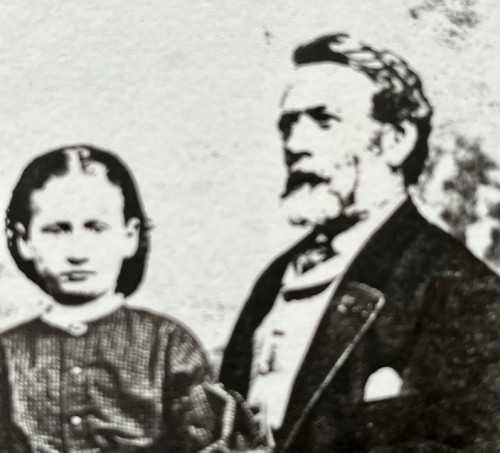
Not surprisingly, that’s Alice Louise on the left in the above photo, but the key detail here is that the man is not her father, which may account for her somewhat somber mien. The distinguished gentleman on the right is James Campbell, her maternal grandfather, with whom she lived most of her childhood. This was due to the death of her mother, Ellen Esther Campbell in 1858, when Ellen was 22 and Alice was only two years old, and then the subsequent abandonment by her father, Edward Louis Button, departing Milwaukee for points elsewhere after depositing the orphaned Alice in his in-laws, the Campbell’s, capable hands. Alice’s father ultimately remarried and had another child in Chicago, but there’s no evidence the two ever saw each other again. (The Button family is another fascinating tale, but that must wait for another time.)
James and his wife Helen Wallace had immigrated to the US from Scotland in 1842 and by the 1850s he was thriving as a trunk maker in Milwaukee, He and his sons worked on all manner of leather products, including boots and shoes, and this allowed him to provide handily for his daughter’s child, at least materially.
Milwaukee Wisconsin in the mid-19th century was a bustling industrial hub, expanding rapidly with an enormous influx of immigrants from all across Europe, particularly Germany, Ireland, and Poland, pushing the city to quickly become a center for manufacturing and brewing and a leading hub for grain exports.

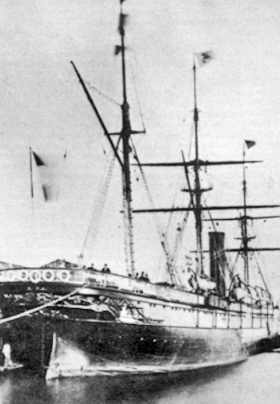
Across the world in Ulm, Germany, Alice’s future husband, Joseph Julius Sellmer, had heard the siren song of Milwaukee from an uncle and decided to come and see for himself. Originally from a family of book printers, Julius was keenly aware that his hometown had just become a “fortress city” in the German empire, meaning nearly university conscription for all males in the city. Appearing to want to skip the draft, Julius applied for immigration at the age of 19, and in December of 1870 boarded the “SS Hansa” for the typical 16-day trip from Bremen to New York and joined the roughly 350 or souls who made the trip in steerage.
Julius indeed traveled to his uncle in Wisconsin where he began his career as a bookkeeper. Shortly after his arrival in Wisconsin, he somehow crossed paths with the Campbell/Button clan, and apparently made a very VERY deep impression on the 15-year-old Alice.
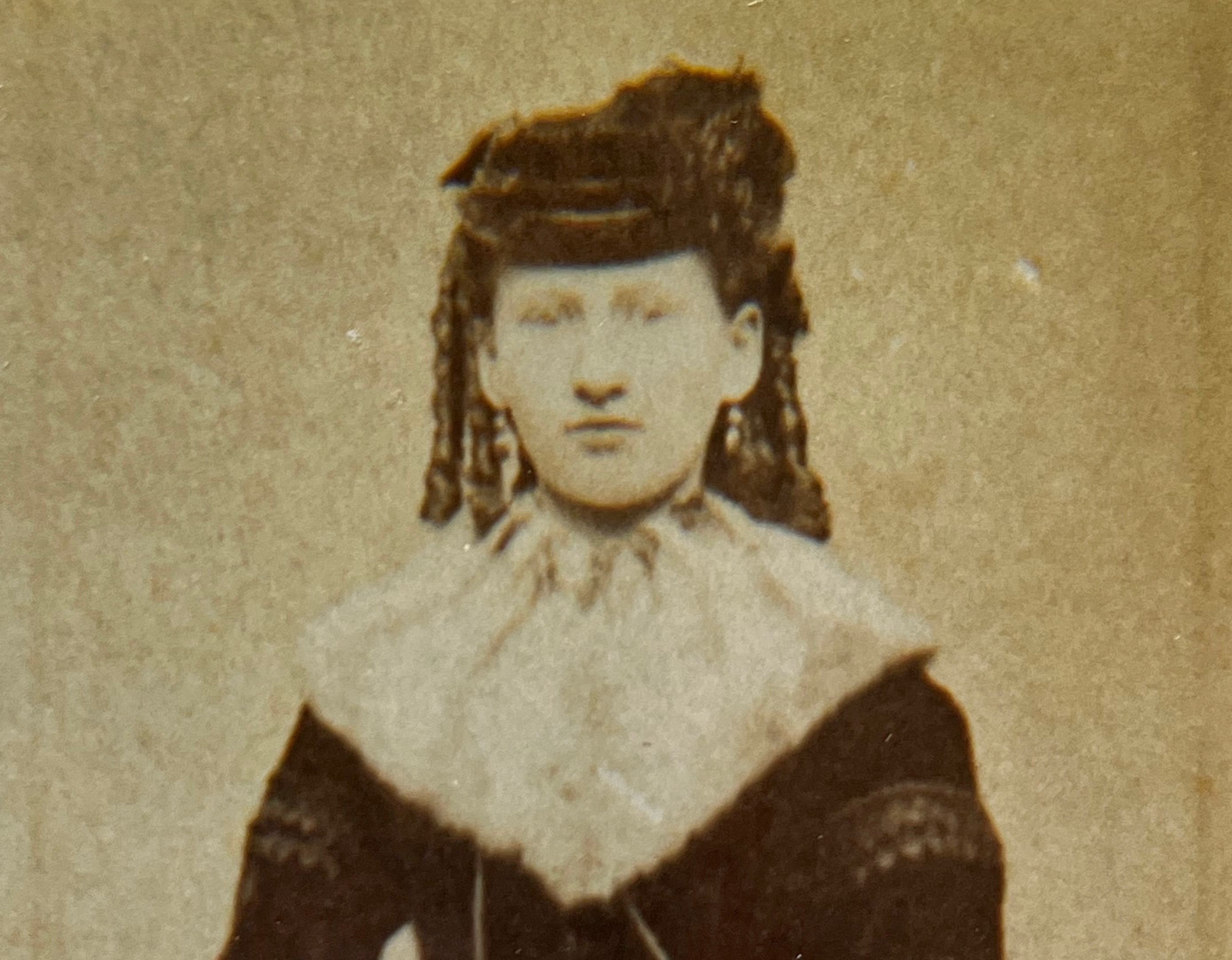
Writing to her uncle shortly after meeting him, Alice’s initial impressions seemed pretty positive:
Watertown, Friday May 26, 1871
“Dear John,
I received two letters the 23th and am very glad to hear that the rat is dead it will not trouble you any more. Papa (her grandfather) thinks we will come home to-morrow start from here at one o’clock so you see we did stay here longer than you thought we would. Papa says he never enjoyed himself so well everybody is just so kind. I have got acquainted with a young gentleman, Julius Selmer he is Mr. Ricker nephew he has been to Italy all over it and in Scotland at Peterhead to New York Chicago than down here. Mr. Ricker asked Papa if he could get a situation for his nephew down in Milwaukee and Papa said he did not know if he could or not. I brought my butter in and gave Barbara some and the other Mr. Ricker. Papa is telling every one that it is the best butter they ever tasted. You know I churned made and salted it all my self. How is the gift concert? How much did I get? Did Nettie or Mamma get anything? I don’t get anything I know. We came into Watertown Thursday, (riding in) the cars (were) Papa, Mr. Ramsey Jr., Aggie and I. Mr. Ramsey rode in the buggy. Papa and Mr. Ricker have gone up to see John. I did not want to go so I stayed to Barbara’s. I do not think of any thing more to say but I will have lots to tell about Papa when I get home. He has let me have my own way all the time so I will say good-by till tomorrow and then I will tell you lots more. I remain your Niece Alice P.S. Excuse lead pencil please.”
(The references to Italy and Scotland in the above letter are most puzzling; there is no evidence to suggest any of that travel, but perhaps it fired the imagination of his young admirer.)
Throughout the following years 1871-1877 that most probably composed their lengthy courtship, Julius was busy trying to find a way make a living and thereby earn his piece of the American Dream. After his year of bookkeeping, he briefly worked in the furnace business before being employed by Charles Stein & Co. in the woolen wholesale and hat and cap business. He became a naturalized American citizen on December 18, 1875, and his passport was issued four months later. It described him as being “5’7” with blue eyes and brown hair.”
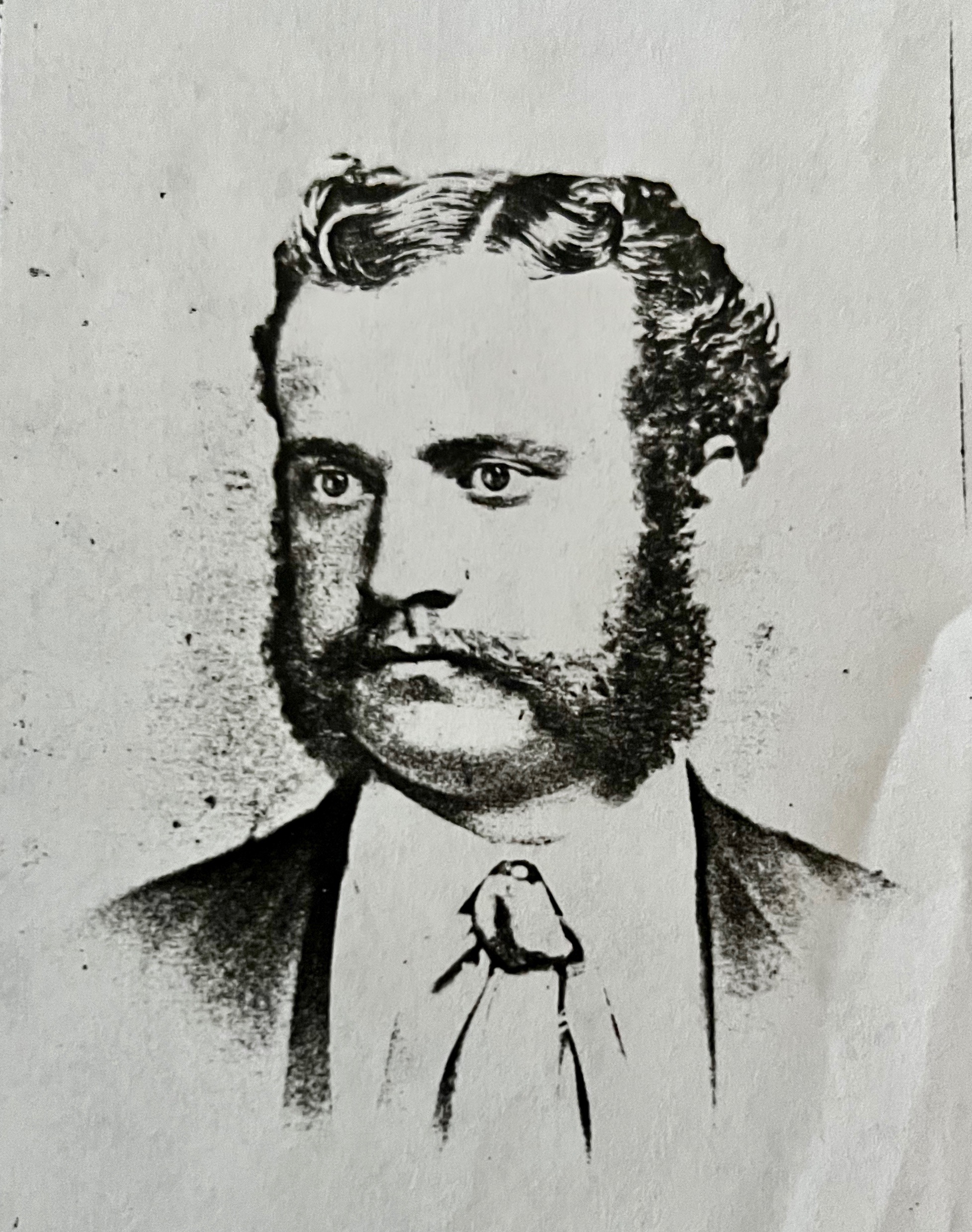
A family photograph shows Julius as a serious young man gazing slightly off-camera with light brown curly hair and significant mutton-chop sideburns that arc across his prominent cheeks into a mustache; perhaps an effort to appear older than his natural age. His American passport was issued on April 20, 1876 when he was 26 years of age.
Much to no-one’s surprise, I imagine, Julius and Alice were finally married on the 28th of August 1877. At that time, he was 27 and she 21.
If number of progeny are any indication, theirs was a happy and extremely fruitful marriage. Julius and Alice welcomed the first of their ten children in August of 1879, of whom eight lived to adulthood, and two – Louise and Anita – are pictured below. The two who died were one of two pairs of twins, which I have now learned were prominent on both sides of my material line.
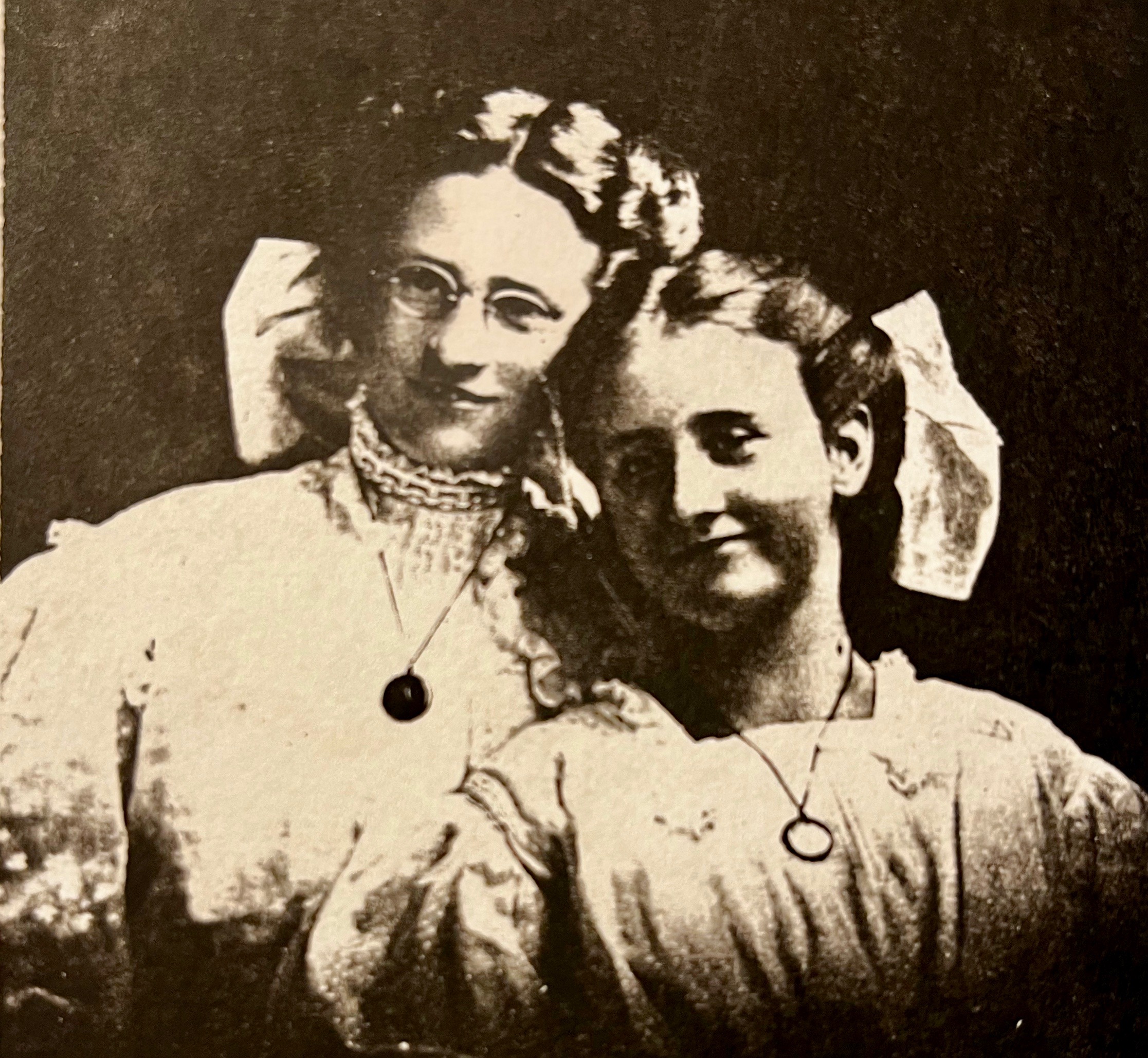
The family’s life and fortune took a significant turn when Julius went to work for the Delorme and Quentin Soap Company in 1885. Shortly thereafter, in 1890, Julius and his partner Arthur J. Morawetz managed to buy the firm as well as another going concern called the Crystal Soap Company, which had begun in 1872. A growing country with a huge industrial focus would have a lot of dirty workers, it would seem, and a soap manufacturer, if clever and hardworking, could create and sustain a large commercial venture. Julius and mostly of his children were to do just that over the course of the next 40 years, overseeing the development of the firm and its subsequent sale to the Palmolive Peat Company which later merged with Colgate, another soap and candle maker of the time.
Sadly, this apparently happy domestic and professional life was not to be long-lived. The wear of three decades of hard physical labor and running a company, as well as the financial demands of an ever-expanding family, became apparent 15 years into Julius’s ownership of the company. “We regret to learn that Mr. Sellmer of the Crystal Soap Company is quite ill,” recorded the American Soap Journal and Manufacturing Chemist in late 1900. He died on January 16, 1902 at the age of 51 after being in “poor health” for some time, and was buried two days later, suggesting his demise has been anticipated. The cause of death as listed in the death certificate is “Morbus Brightii,” Bright’s Disease, or acute nephritis, an inflammation of the kidneys which apparently he had had for some time. He had been an active member of the Masonic fraternity and they assumed charge of his funeral.
Alice, who became a widow at age 45, lived on without her husband for only another ten years. During that period she had to endure the loss of her son Gustave, also of acute nephritis, at the age of 19. Fortunately, the other seven surviving children lived with her until her death in 1911.


 Berlin Byways
Wonderful job of research and very skillful job of fitting (I won’t say “weaving”) it all together into an interesting story for us! – Kim
I’m so impressed at the level of detail and story you’re able to share about your family! Well done, Carla!