East and west – A last look at Lithuania

The day I left Vilnius for Berlin, I took one last walk around the Old Town. As you can probably tell, this little burg has stolen my heart, and I hope to return before too long. This set of signs, however, standing just outside yet another amber souvenir shop, speaks volumes about Lithuania today:
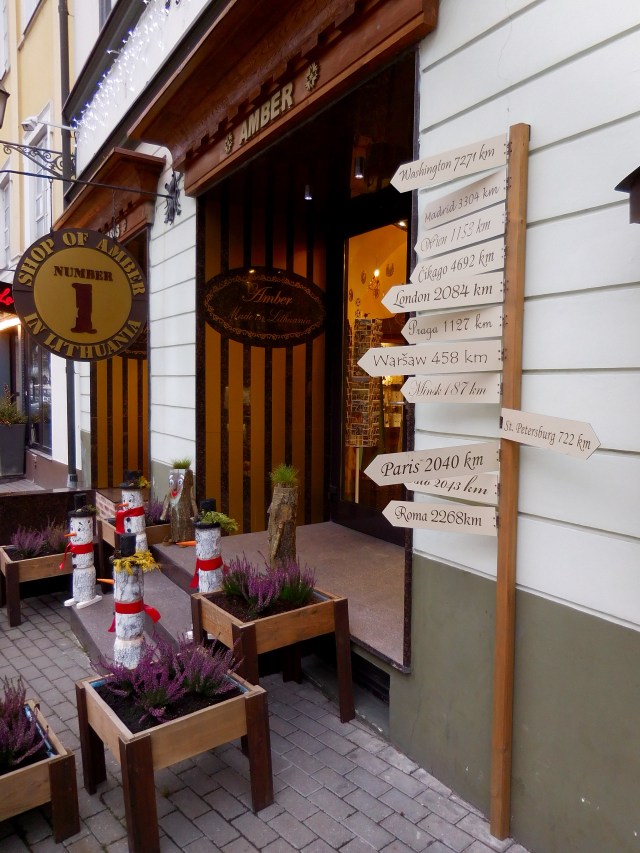
DSCN1015

Moscow? What Moscow?

You will quickly notice that *only one of the signs points east,” and this is significant for many reasons. More than any other of the four post-Soviet countries I have visited so far, Lithuania (and probably its neighbors to the north) have thrown off the physical and linguistic shackles of its ~45 year tango with the Soviet Union and has unequivocally faced west, towards Europe and North America. There are no signs anywhere in Russian in Vilnius, even though there are still a goodly number of Russian-speaking citizens and many visitors from Belarus and Russia. All the signs are in Lithuanian, and if they’re bilingual, it’s with English, and I mean all the signs, everywhere. Not a Cyrillic character to be seen, all torn down, pained over, chiseled off the wall. And it doesn’t stop at the written word. Every charming young service person I interacted with spoke nearly flawless unaccented English, which was amazing. (The older folks were, for the most part, grateful I spoke a little Russian.) They.have.moved.on.

So, with that in mind, the Lithuanians are also enjoying their official return to Catholicism with great gusto. Here’s a shot of the little Christmas market in front of the main cathedral. It doesn’t hold a candle to the big boys in Berlin, but it was plucky and fun and people were having a grand time. You’ll note the belfry is decked out in greens, and apparently Santa’s inside and ready to be photographed with the little ones:
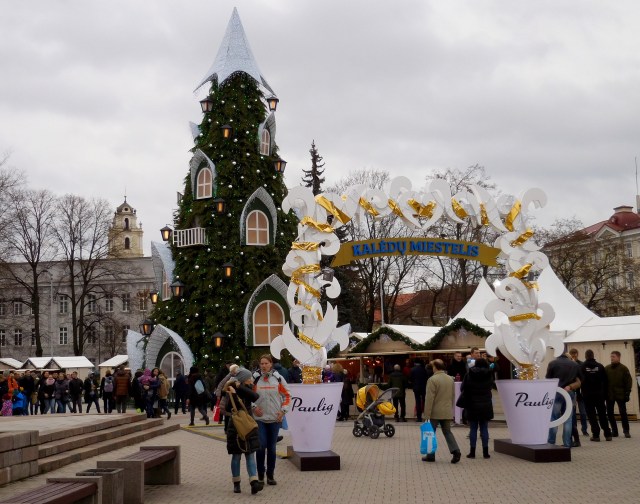
DSCN1011

Hot wine AND beer

A little further on around the corner and nestled in a bend of the Vlina River, one reaches one of the indeed quirkiest parts of the city, the Republic of Uzupis:
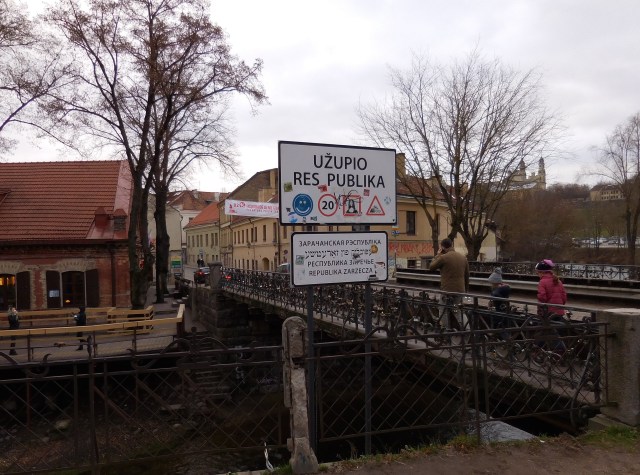
DSCN1016

No passport required

Wiki tells us “in 1997, the residents of the area declared the Republic of Užupis, along with its own flag, currency, president, cabinet of ministers, a constitution … an anthem, and an army (numbering approximately 11 men). They celebrate this independence annually on Užupis Day, which falls on April 1. Artistic endeavours are the main preoccupation of the Republic…Copies of the 39 articles of the Republic’s constitution and 3 mottos – “Don’t Fight”, “Don’t Win”, “Don’t Surrender” – in 23 languages, can be found affixed to a wall on Paupio street in the area.”

Sort of its own little Montmartre in Paris or Christiania in Copenhagen, as it were. I strolled around for a bit, but it wasn’t too compelling on a drizzly afternoon, so I left after taking this shot of perhaps the republic’s mascot:

DSCN1020

Ars longa, vita brevis

I love browsing bookstores, even when I can’t read a word of the language, and I was particularly touched to see this picture in every bookstore I visited:
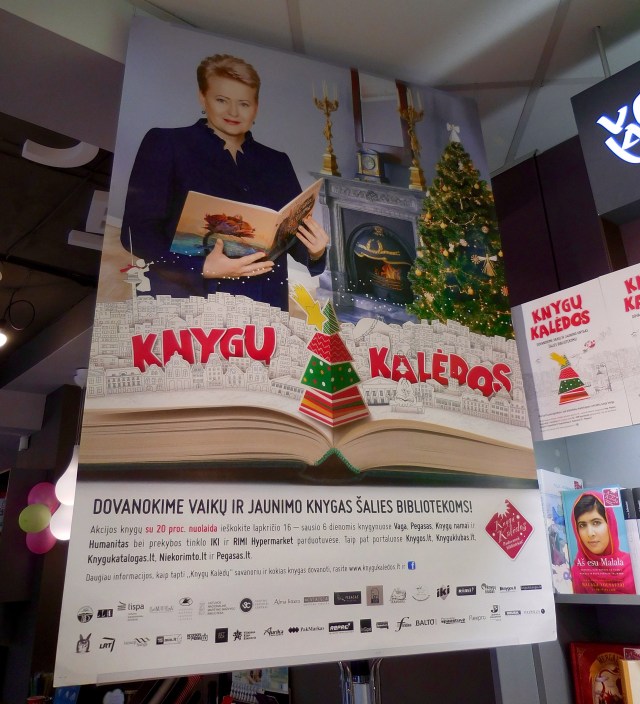
DSCN1062

All I want for Christmas…is books!

This is Dalia Grybauskaitė, the president of the country, encouraging people to buy books for Christmas (I think; it could be something far more sinister). You can see Malala looking on approvingly from the side. How cool is that?

So then it was time to head to the airport. On the quick train trip (seven minutes, .70 Euro), I took one last endearing picture. Lithuania, you’re fun and you’re gutsy and and you have a vision about who you are and what you want to become. I salute you.
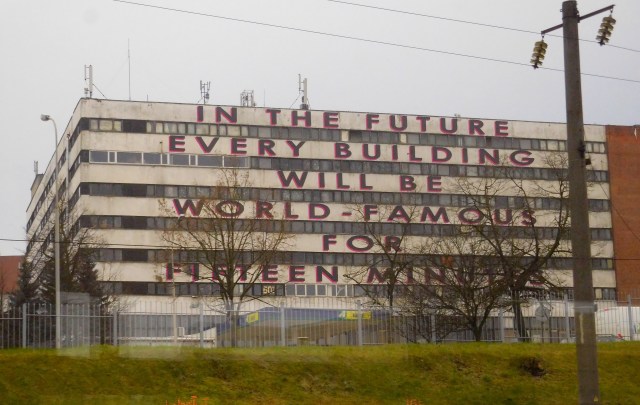
DSCN1082

Andy lives

On to Berlin.


Posted in Uncategorized | 3 Comments

The bravest person I know

During my time in Batumi, Georgia, I met a number of strange and wonderful expats from a variety of countries, mostly young and full of piss and vinegar. I remember with great fondness one night listening to young Ukrainian and Moldovan backpackers playing “Buena Vista Social Club” on their way to Iran. Places like Batumi attract those of us who are intoxicated by the lure of ‘the road not taken,’ and while I may have not wanted to take all of them home to mother, my life is far richer for having encountered each and every one of them. One or two, like K (not so young) in Berlin, have become a somewhat regular feature in my life, but most of the others just passed through for a shining moment and are now either back home or in some other far-flung corner of the universe. One went on to the Peace Corps in China and is now in grad school in Philly; one went back to Canada where he is ‘being the change;’ one became a Fulbrighter in Bulgaria and now studies at the LSE, another Fulbrighter headed to Malaysia and is now (I think) in Somaliland. You get the drift.

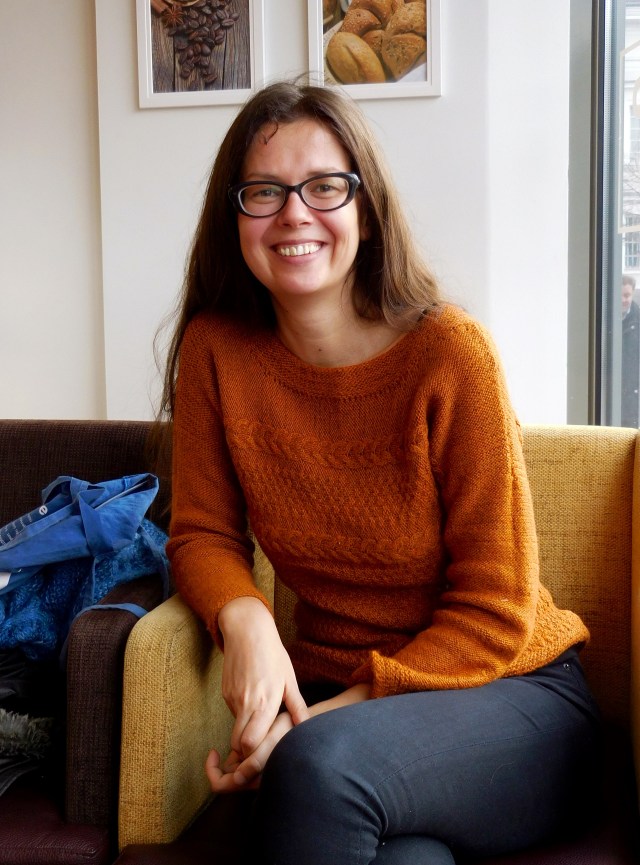
But perhaps none of them has touched my heart and impressed my mind as much as my Lithuanian friend, J, seen below.

DSCN1030

Saving the world

It was sheer random glorious chance that I managed to be in her home country this very week during one of the rare short times that she also inhabited it. We met for coffee and a chat this morning before she had to run catch a plane.

When I met J, she was working for an NGO in Batumi which ostensibly was trying to help “eco-migrants” in Ajara (the region in which Batumi is located). Like me and every other Western female I met there, she was exasperated by how women were treated in the country in general and in her office in particular; we, along with the others, kept our spirits up through the conversation club and other venting get-togethers whenever possible. She didn’t stay long; she soon had a better offer and off she went.

The better offer was with Oxfam in the West Bank and Gaza, helping with the allocation of water resources, where she has been working for the last two and a half years. Today I learned a lot more than I knew before about the situation there, one that makes the news occasionally, but which gets lost under the clash and pounding of all the other world catastrophes.

The West Bank, I learned, is divided into three parts. The first is governed by the Palestinians; the second by a joint Palestinian-Israeli group, and the third (60% of the whole) by the Israelis, where the new settlements are built. Her office is located in the first part, in a compound, which is as safe as it gets, but she, like everyone else, is subject to checkpoints and long waits inflicted by grumpy young Israeli soldiers (universal conscription between the ages of 18-21) when she moves about the area. She works with a colleague in Gaza via Skype and teleconferencing, but she never actually goes there; she can’t, *because no one can.* What I hadn’t realized until today is…no one enters Gaza, no one leaves it. There are 1.8 million people in Gaza, an area roughly twice the size of Washington, DC, who are in virtual prison for life, with no hope of anything aside from the 140 square miles along the coast. And, not surprisingly, there is very little water available, or food, or fuel.  No wonder there are intifadas. Here’s more if you are interested:

https://www.oxfam.org/en/countries/occupied-palestinian-territory-and-israel

During her time in the West Bank, J has learned spoken and written Arabic, this adding to her (at least) Lithuanian, Russian, and English. I asked her what was has been the biggest surprise in her time there, and she answered “the resiliency of the people.” She is amazed at how the Palestinians, for the most part, admittedly, are normal people living normal lives with normal concerns. She has not gotten to know any Palestinians particularly well – like Georgia and most of the world, the family is the basis of social life – but after two and a half years, and some careful observation, I don’t doubt her words.  I asked what she misses about life in Lithuanian, and she said occasionally the “easiness” of the west, meaning control of time and availability of resources.

What I also learned today is that she is finishing up her work in the West Bank, and is shortly moving on. She has taken a six-month (renewable) position with the French branch of Action Against Hunger (ACF International) working as an “advocacy expert in public health and nutrition” in….Mazar-i-Sharif, Afghanistan, in the north of the country, near the Turkmenistan, Uzbekistan, and Tajikistan borders. Sigh. Gulp. She smiled as she delivered the new, saying “You probably don’t want to hear this.” Hey, it was hard when she told me she was hitchhiking back to Lithuania from Georgia, but I just had to let that go. And I just have to let this go, as my dear friends just have to let me go as I climb on yet another plane to yet another far-flung destination. As her airport bus was approaching, I told her that I loved her, that I supported her, that I was always there for her, and that I stood in awe of her contribution to world goodness. Please hold this wonderful human in your heart for a moment.

Posted in Uncategorized | 2 Comments

More adventures in Vilnius

Okay, that last post on the Jews was a bit heavy, but as I just said to someone in an email, it demanded to be written before I could move on to anything else. I believe that these stories must be told, that these brave souls must be remembered, and that we must take a moment to consider and understand what consequences our actions — and/or our inactions — may bring about.

So now I want to return to the positive and interesting things that are still available to be observed, enjoyed, and shared in today’s Vilnius. Today was the day to check out the culture vulture stuff, you know, the Cathedral, the Palace of the Grand Dukes of Lithuania, the National Museum, the Gediminas Castle Tower, the Benedictine Gardens, the Presidential Palace, all the stuff that you get on the school tours.

Now before you panic and worry that I’m going to subject you to endless pictures of cherubs and crowns and canons, the answer is no. No because…..cringe….because….I never thought I’d hear myself say this, but ‘ya seen one, ya seen ’em all.’ This isn’t entirely true, BUT since Lithuania shared a good bit of its long history with Poland AND I spent two weeks crawling all over Poland last spring cruising every museum and castle I could find, there was a lot that appeared to be quite similar in form and substance here, and while I was happy to pay my two euros and walk quickly through the castle/museum/garden, I won’t do that to you. I’ll share just the highlights, and then quick, let’s get back to quirk, of which there’s plenty to go around.

Okay, off we go. You’re probably tired of THIS kind of shot already, but I never will be. Here’s just a normal ‘walking around’ view of the Old Town:

DSCN0992

Hauntingly Hapsburgian

There’s just something about the Baroque symmetry, the onion domes, the invitation to take a peek around the little corner up there…it just doesn’t get old for me. As I write this, though, the Hari Krishna are parading up and down a nearby park space. When worlds collide…

As I mentioned, the Poles and the Lithuanians share a long and complicated past. I’m hoping to write a blog about the similarities and divergences between the two countries and cultures, not that I’m any expert. Like parsley and cilantro, however, from a distance the two look fairly similar, but pop one in your mouth and the difference is instantly clear. Having seen the Polish perspective on the shared history is fascinating because some of Poland’s heros are Lithuania’s rebels; some of Lithuanian’s powerful leaders are Poland’s thugs and brigands. It’s all a matter of perspective.

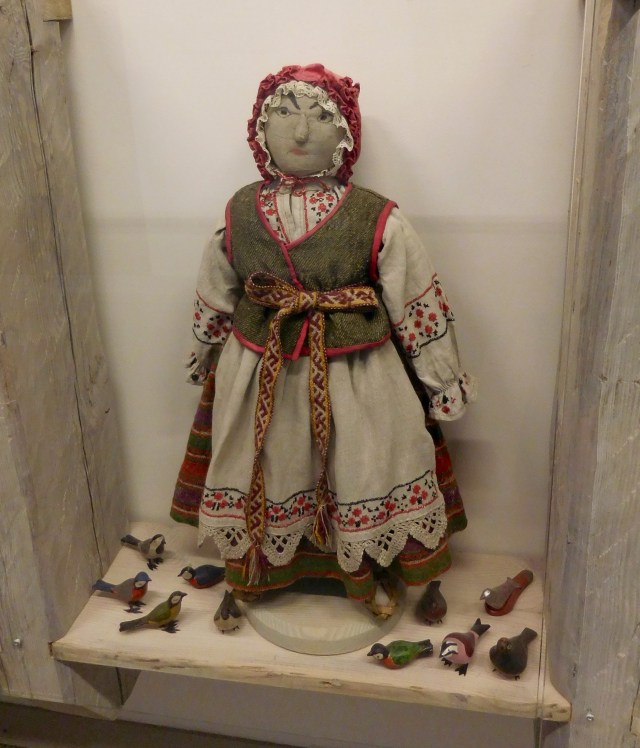
Okay, I promised no crowns and cherubs, but I just have to include a shot of a folk art doll in regional dress with some birds at her feet. I’ve seen these birds in a lot of arts and crafts around town – not sure what the meaning is, but it’s clearly an important symbol. Visiting here  in the capital city, I’m sure I’m not getting the “true fruity reality” of the rural country and traditional culture – my guidebook tells me the true Lithuanian soul is “pagan, rural and lighthearted.” Here’s a little of that:

DSCN0983

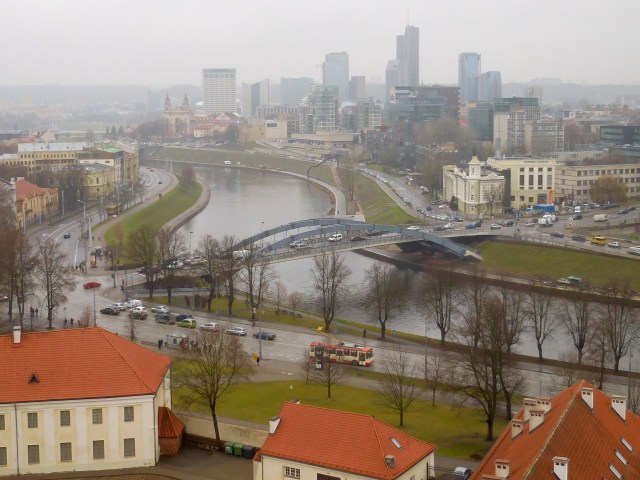
You’ve now seen a lot of close-up shots of the Old Town; here’s a glance at the northern part of the metropolis, the business district, as it were. I’m standing just at the top of the Castle hill; the Old Town is behind me. (No, I didn’t climb all the way up here; there’s a modern and speedy funicular ride available that, while brief, is quite spectacular. I did walk down, though, damp cobblestones and all.)

DSCN0987

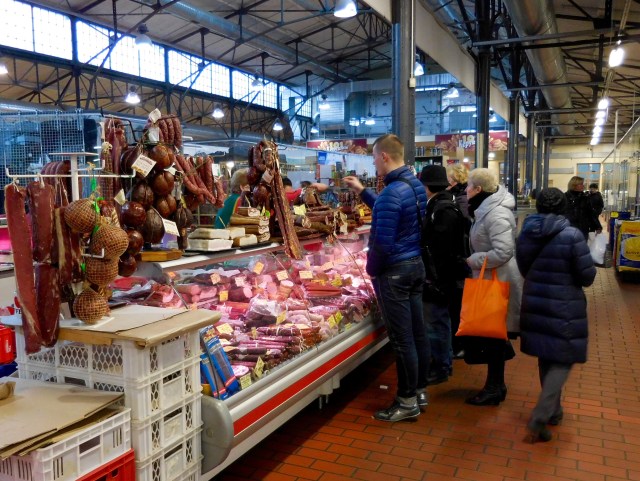
One thing I always love to do in new cities is check the pulse of ‘normal life’ by going to a market. Sometimes it’s a smart upscale urban chain and sometimes it’s a dreary local dispensary filled only with stuff off the boat from the nearest colonial power, but I believe one gets interesting insights from watching how and what people decide to eat. This market today was similar to ones I have seen in Ukraine and Poland; not full, but full enough of truly mouth-watering stuff to make me wish my minibar were a tad larger. Here’s a shot of eager shoppers at a butcher counter. Smoked meat, particularly pork, is big here, as I mentioned before (still haven’t managed to try the pig’s ears in my breakfast buffet lineup):

DSCN1006

Bring on the hog

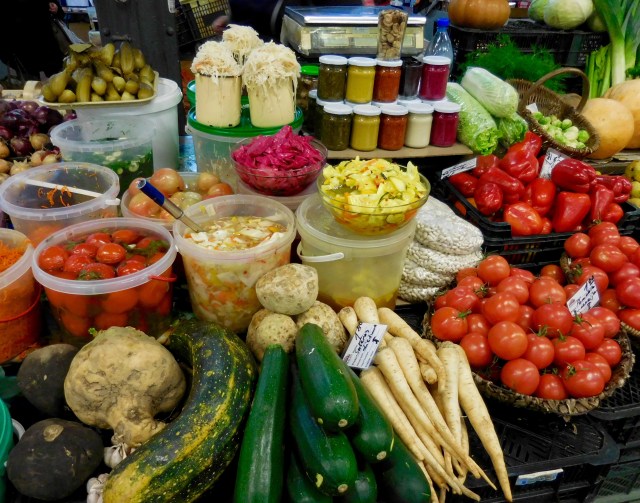
A little further on, there was a truly inspiring vegetable display featuring already prepared slaw and kraut in the middle, just waiting for the busy professional woman to take home to her family:

DSCN1007

Fermentation rules

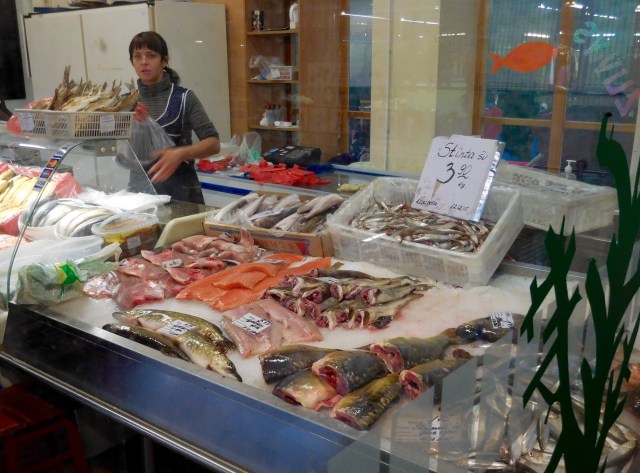
Finally, a shot of the fish counter. I haven’t tried any yet, but there are dozens of varieties available and herring features prominently on every menu I’ve seen:

DSCN1008

Heart healthy

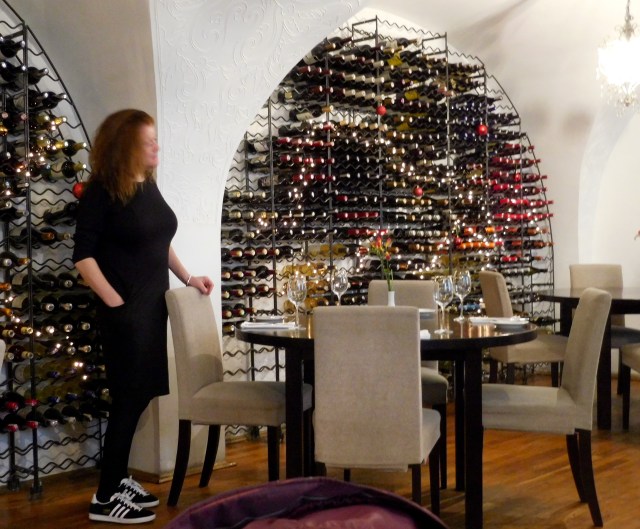
After looking at all this food, I was actually getting pretty peckish myself. As you may know, getting me to the table is sometimes a challenge, but fortunately, Vilnius is really chock-a-block full of charming restaurants serving a variety of good food for really cheap. The wait staff are usually young and stunningly good speakers of English; at lunch today I chatted with a young man who had spent his summer in Brooklyn, New York as a strong back for Gentle Giant Movers. He plans to do the same thing in Boston next year. This is a shot of Bistro 18, where I dined on a fabulous vegetable soup and a terrific risotto. The woman on the left is Ann, one of the owners and operators. If you watched the NYT video, she’s in it.

DSCN1005

Serious Christmas spirit(s)

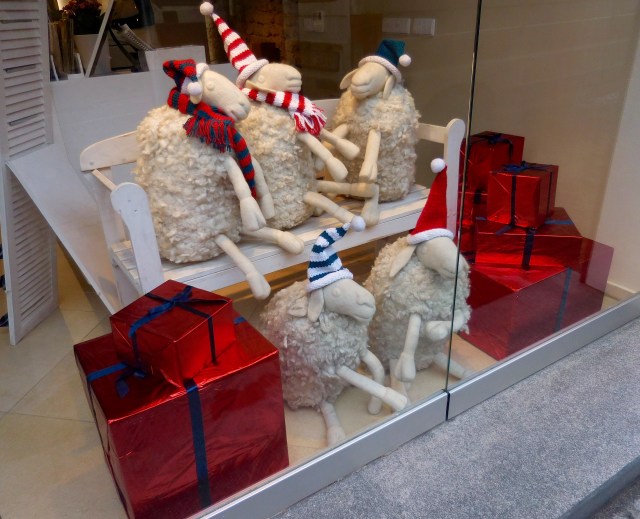
Then it was time to walk off the calories and enjoy what was left of the afternoon light. Here’s a jewelry store window with a friendly barnyard holiday motif…

DSCN1003

Baaaahd management

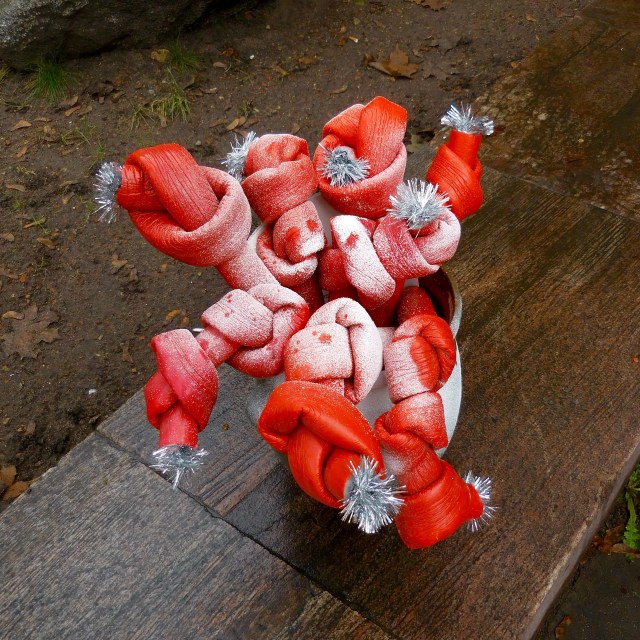
….and descending down the coherence scale a bit we find a festive holiday bouquet of, well, hmm, of, er, I really don’t know…

DSCN0994

Knots to you

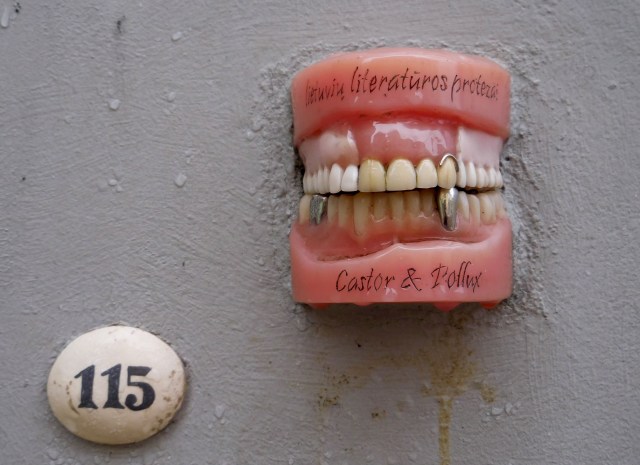
…but I have to finish with what has to be the oddest artistic installation in a long street of them, the colorful Lituratu Gatve. Starting in 2008, local artists decided to decorate the street with mixed media peices related to literature, primarily Lithuanian, but there are others. From a distance, here’s what you see…

DSCN0997

Something for everyone stuck in the wall

…several facades covered with odds and ends that each reflect a different work or author. But I gotta say, this one takes the cake:

DSCN0998

Can anyone say “post-modern?”

Okey dokey then. It’s a wrap. Not sure what tomorrow will bring, but it’s guaranteed to be reeeeeally interesting. I’m counting on it, and so should you.


Posted in Lithuania | Tagged | 1 Comment

Jews in Vilnius

WARNING: THIS IS NOT A HAPPY OR FUNNY POST. IF THIS TOPIC DOES NOT INTEREST YOU, PLEASE FEEL FREE TO ALONG TO ONE THAT MIGHT.

As I travel about Eastern Europe, I spend a great deal of time paying my respects to the memory of all of those who died at the hands of oppressors during the 20th century, of whom there were far far too many. This is an impossible topic to cover in a medium such as this, but I want to share some brief thoughts and images from my pilgrimages today to locations and museums in Vilnius that bear witness to those terrible times.

The brief overview is, as mentioned below, that Vilnius was, as with the town of Lublin in Poland that I visited last March, one of a handful of centers of Jewish learning and culture in Europe. Jews had lived in this region for centuries; there was a stretch of real estate from the Baltics to the Black Sea, the former extent of the Duchy of Poland and Lithuania which became known as “The Pale.” There they had been given special rights to live and do business by various leaders through the ages. Jews traditionally lived somewhat apart from people from other religions; Lithuanian Jews (or Litvaks) did so out of a sense of high theological purity to differentiate themselves from other Jews, most notably the Hassidic sect.

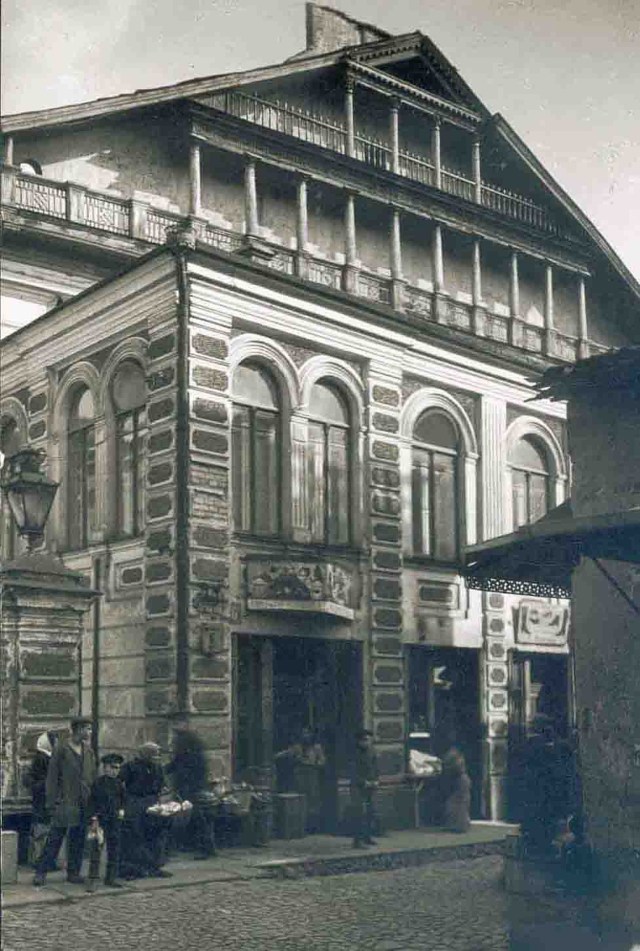
At the time of the second World War, there was, as so often was the case during this period, a thriving community of nearly 100,000 Jews living in Vilnius (nearly half the city’s population), and the city sported somewhere around 100 synagogues (today there is one) in addition to a whole host of related and supporting civic institutions. The Great Synagogue, built in the 1630s, had looked like this up until the early 1940’s:Grande_syna_Vilna

After the war, after the destruction of the community that had supported it, the building stood in repairable ruins until the Soviet administration decided in 1957 that the time had come for a little urban renewal. When I went looking to find what stands *on this very spot* today, this is what I found: DSCN1038

This is the great challenge for Jewish memory here in Eastern Europe. Most of what once was…is just gone. And what replaces it is many different kinds of things, few of them respectful or reverent. For example, there are ruins (here and there; thankfully some being restored). There is flat unreconstructed ground (as in Lviv). There are open fields and parks (as in Lublin). And then there are multiple examples of reuse, repurposing, and denial, as in the blocks of flats above (and most of modern-day Warsaw). The physical history, on the whole, can only be found in plaques and photographs and guided walks and artifacts in museums. That’s all of what’s left. Beat.

Okay, then, so off to the museums and plaques went I. The Vilna Gaon State Museum is actually three sites, of which I visited two. The first and most accessible in terms of presentation and navigation is the Tolerance Center. This beautiful renovation of a former Jewish theater presents permanent and temporary exhibits as well as conferences, seminars, lectures, movies, and concerts. The exhibition space showcases “three authentic interior details” of the Great Synagogue, and there are paintings by notable Jewish artists as well as the expected historical background material and a very poignant small space dedicated to the children killed during the Holocaust. (See http://www.rescuedchild.lt for details.)

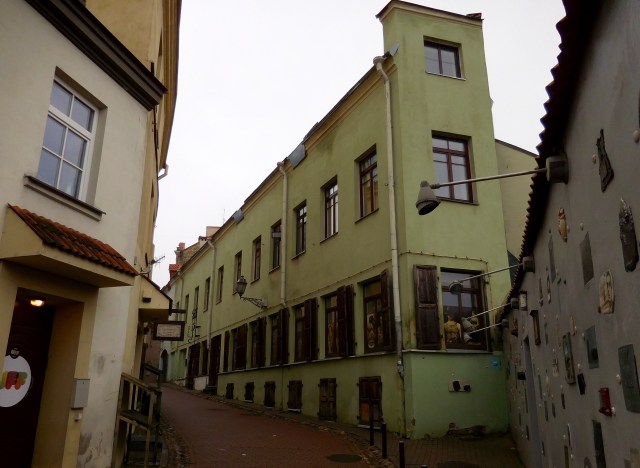
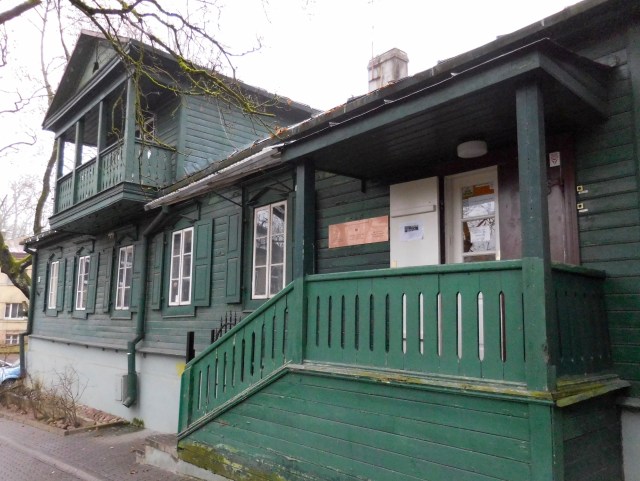
The second site is the Holocaust Exhibition, “Malina,” located in “the little green house.”

DSCN0945

Malina is the word for a ghetto hideout, the kind of place  where people hid in piping, chimneys, attics, that kind of thing, until the ghetto itself was taken down. There is a indeed reconstructed malina on the top floor of the building and a video to accompany it. The main part of the exhibition is archival, showing everyday life in the ghetto during the period and some information about the unhappy conclusion of the era.

The third site is the Paneriai Memorial, an area containing seven pits near a railway station outside town where it was determined the Nazis killed 100,000 people, 70,000 of Vilnius’s Jewish population and others including resistance fighters, Roma, communists, Catholic priests and other undesirables of the day. It is considered the second biggest place of mass execution in Eastern Europe after Babi Yar in Ukraine. Frankly I do not think I will manage a trip there, so I determined to pay attention to the places I did visit.

That being said, there  was a sculpture and a plaque outside the little green house that initially caught my attention.

DSCN0944

Hmm. What’s this?

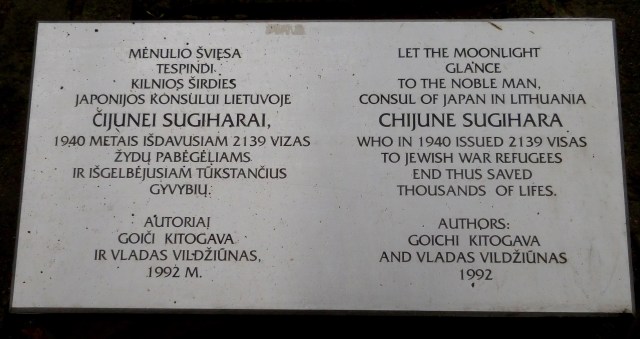
Nearby signage provided a little insight:

DSCN0943

Minor misspelling aside, what this doesn’t tell you is that Sugihara-san, a dedicated career diplomat, was seriously criticized after the first 1800 visas were issued and then promptly fired from his job when he returned to Tokyo after the war. Looking at this memorial reminded me of the feelings I had last summer in Nagaoka when I visited the memorial for Isoroku Yamagato, the Japanese admiral who had been the most unwilling architect of Pearl Harbor. As you may recall from that post, he was a deep pacifist, loved the United States, and actually was trying to inflict the least pain possible under the circumstances. This is not to say that Japanese people have any particular market on extraordinary sacrifice; just that these two souls and their choices of action have affected me deeply this year. Here’s a shot of some of the people Sugihara-san tried to save, standing outside his consulate in 1940:

DSCN0954

There are quite a few other diplomats, I’m learning, who took similar actions during this period. (There may be a book in this.)

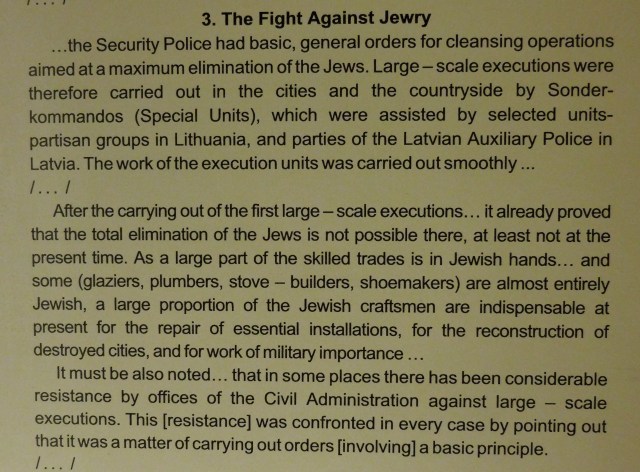
One always wonders how and why the Nazis were able to marshal so many forces to do so many terrible deeds. This translation of the actions being taken behind the murder of Jews in Lithuania and by extension everywhere else gives one insight:

DSCN0946

…that principle being, of course, that Jews were sub-human and at risk of destroying the Aryan gene pool. That being said, if it weren’t enough to eliminate ALL the people, the entire physical manifestation of the community in purely physical terms had to be eliminated as well.

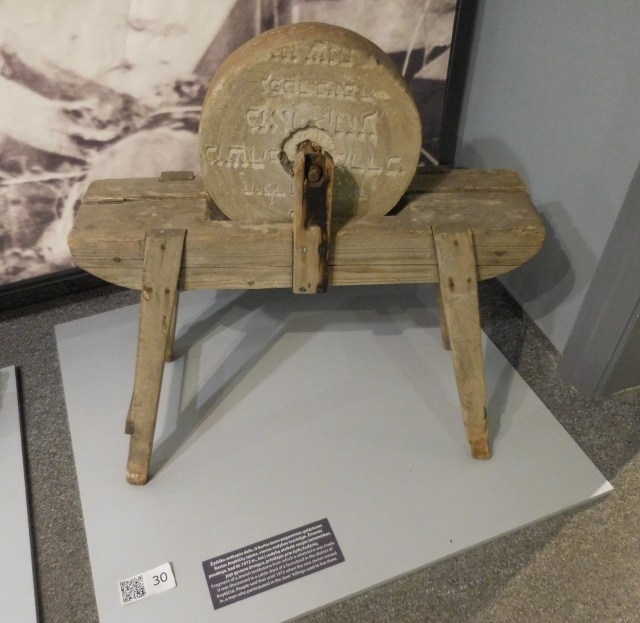
There are many examples of this, of course, but the use of cemetery tombstones is particularly poignant. Here is a whetstone used by a farmer for sharpening knives and other objects:

DSCN0955

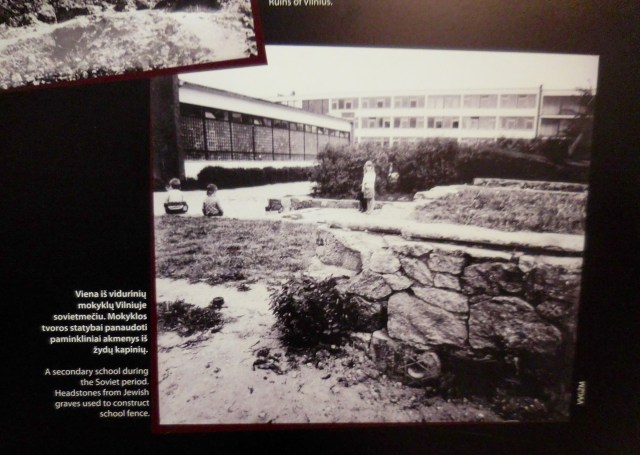
And if small home appliances weren’t enough, the thrifty Soviets used similar material in their some of their building projects during the post-war era, here for example a fence at a secondary school:

DSCN0951

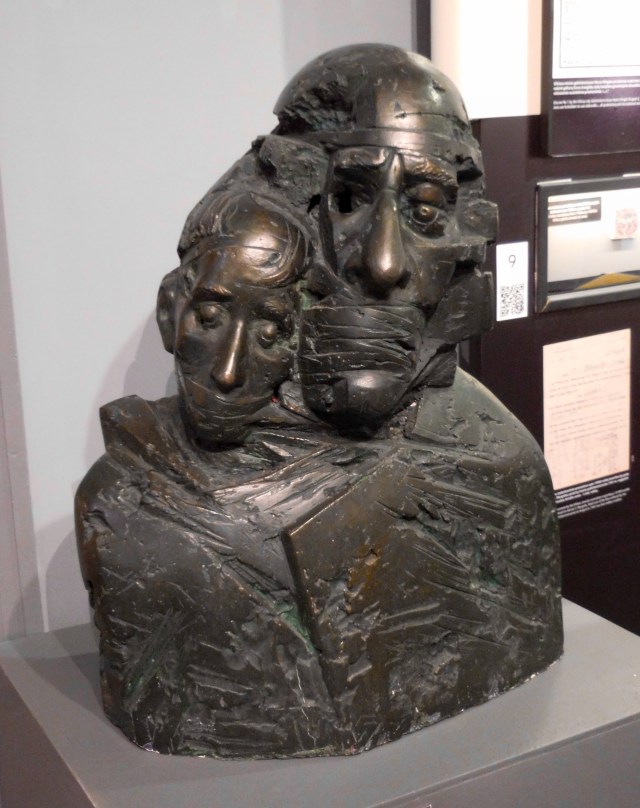
Let’s take a moment to acknowledge the simple fact that there ARE Jewish museums in Vilnius (and other sites throughout the region), a tribute in and of itself to the enormous determination and fidelity of those few who indeed remained or returned. I salute their efforts and wish them well. I leave you with a final image, a sculpture representing those who had to suffer what many of us can not even imagine. May that always be so.

DSCN0950


Posted in Lithuania, Uncategorized | Tagged , | 2 Comments

Vilnius is “quirky,” said the NYT…

…and of course that’s exactly the kind of thing to get my juices flowing. Ostensibly, the purpose of this trip to Lithuania is (ahem) research on the memoir I’m writing about Uncle Bob, but that photo will probably take 15 minutes and the rest of the week is simply because, like many other places, the Baltic nations are “edge zones” and therefore magnetically attractive to me. Having seen Poland in March of 2015, I am very curious to see similarities and differences in history, culture, and of course, responses to the staggering catastrophe that was the 20th century for the people of this region.

My first day in any given new city is what I call the “death-march acculturation walk.” The goals are 1.) to spend time in the sunlight to reset my internal clock; 2.) to get a general sense of what’s what and where; and 3.) to take the temperature of the town, poking my nose in anything that catches my fancy. Once these goals are accomplished, I usually set a more organized agenda for the rest of the visit, and today was no exception.

Vilnius is complicated, to be sure. Not as old as some places in Europe, it began after the Christian conversion of the country in the later Middle Ages and seems to me to be covered in churches, many in a stunning Baroque style. The central city itself is very low and dense – in many ways it resembles a village rather than a metropolis, as noted by the NYT in the link at the end of this post. It became a major center of Jewish life and learning for over 500 years as well, often referred to as the “Jerusalem of the North.” Politically it has ping-ponged back and forth between being in Lithuania, Russia, Poland, and the Soviet Union before the country itself finally wrestled back its independence in September of 1991.

Here’s a shot of one of those Baroque beauties. I have no idea which one this is, since the little tourist map lists 30 of them, but it gives you an idea:

DSCN0939

Saint Somebody-or-Other

Since Lithuania is so far north and today was so clear, you can see the long shadows even at noon when this shot was taken.

Although the Old Town is a UNESCO World Heritage site, and deservedly so, there is, like many post-Soviet urban settings, a lot of variation in the architecture. Beautifully preserved and maintained sites, like the one above, may be cheek-to-jowl with considerably less scenic venues. There is a lot of renovation in progress, thankfully, but there are also a lot of places that look a bit run down. I’m told (again, the NYT) that things have changed considerably recently (entrance to the EU probably had a lot of to with this), but there more work in store, I hope. Here’s a shot of a less, er, classic facade:

DSCN0926

NOW we’re talkin’ quirk

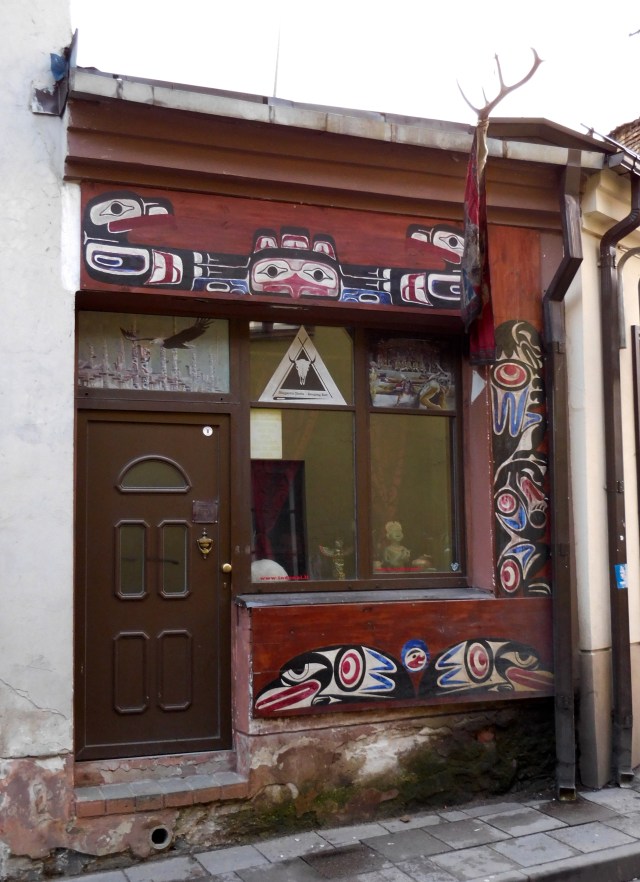
And here’s a motif I really didn’t expect to see here – the Tlingits come to the Baltics. Go figger.


DSCN0925

With no real plan, I truly rambled today – a bookstore here, a cafe there, the Museum of Genocide Victims, and the Amber Museum before stopping for a bit of a nosh at one of the local brew pubs.

I didn’t take photos in the Museum of Genocide Victims, but let me tell you it was quite the experience. The building was the former Gestapo HQ during WWII and was then turned over to Putin’s old KGB friends for the post-war reign of terror that was inflicted on the locals. The basement is gripping for its being maintained in near-perfect stasis from the handover of the former owners in 1991 and one gets a close look at surveillance apparatus and techniques, holding cells, interrogation cells, a special sound-proof room for torture, and the space used for executions. It just wasn’t pretty.

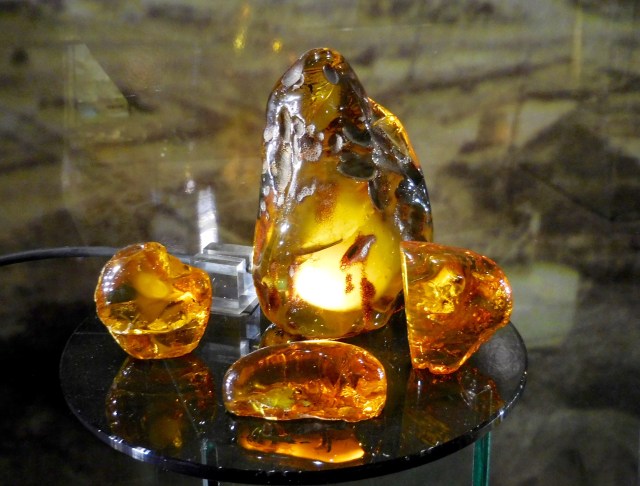
Moving along, a little natural beauty as a pick-me-up. The Amber Museum showcases some fascinating information and displays in the basement and then sports a lovely jewelry shop on the ground floor, complete with a friendly staff member who treated me to amber liquor, basically moonshine with bits of resin floating around in it. Baltic amber, found mostly on the coast of Russian Kaliningrad, is composed to two types: the inner wood derivative which is more opaque, and the type derived from the outer layers of the tree, the transparent material shown below. It’s most precious with trapped insects.

DSCN0938

The German word is Bernstein, for “burning wood.”

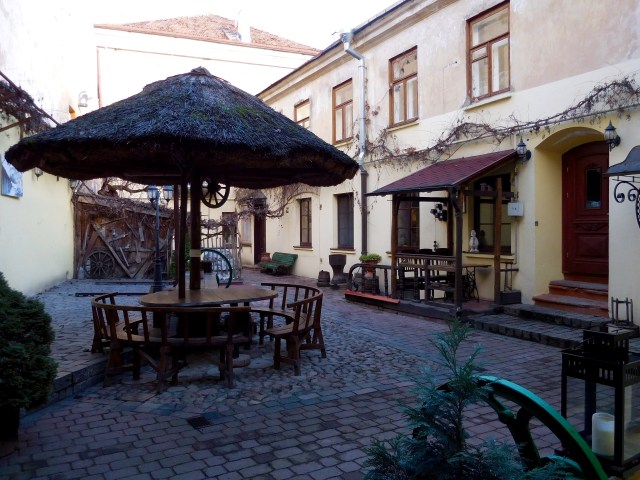
On the same street, here is a little courtyard where Nobel-prize winning Polish poet (and diplomat and professor) Czeslaw Milosz wrote some of his work. He was born nearby when the region was Poland in 1911. You can see some of the typical two-and-three story architecture found around the city as well.

DSCN0934

Watch for the muse

On the way back to my hotel, just before a late lunch, I ducked into a modern mall to warm my hands and toes. Along with the usual retail suspects, I was amused to spot the following sign for a product that I never knew required regional accommodation:

DSCN0933

Just because

About the time I was going to keel over, I visited the Jewish Cultural Center to plan my trip to those sites in the coming days. I asked about a good place for lunch and was directed to Snekutis, one outpost of the local brewery. The beer and soup were delicious but the ambiance was a bit on the grunge side, so I didn’t make it a long visit. I did notice, though, a list of some of the local delicacies available. This may go a long way to explain why there are not Lithuanian restaurants in every city. I could have chosen:

  • Smoked pigs ears with peas and species (I do hope this is a vowel transposition and not an issue for the World Wildlife Federation)
  • Latvian peas with crackings
  • Fried curd pancakes
  • Salad composed of fried bread, cheese, beans, and mayonnaise

(You know those extra five pounds I was planning to gain on this trip? Just sayin’, they may have to wait until Berlin.)

For a great short video and article about Vilnius, click on this link from the New York Times published in July of 2015. You’ll get a sense of the language as well.

Stay tuned for more adventures from the 56th latitude.

Posted in Lithuania, Uncategorized | Tagged | Leave a comment

Budget travel zones

This trip, I’ve decided to see how low I can go – in terms of ticket prices and weight carried. These things are connected, but we’ll get to that in a minute. For this latest trip to Lithuania and Berlin (again!) I decided to branch out a bit from my “go to” Turkish Airlines and see what some of the competition is doing.

A friend had bragged about a seemingly unbelievable low price on WOW Airlines, the budget Icelandic brand (and allegedly Iceland’s “most punctual airline”), and I checked it out. The website shows you exactly how much a ticket will cost on any give day and let me tell you, on some days those numbers can be impressive, and on others not so. But through some chicanery I managed to get a round-trip ticket from Boston to Berlin in December for just over 300 USD. Yup. Could hardly believe it myself.

The devil, of course, is in the details. You get nuthin’ at all for free with the exception of five kilos of carry-on. That’s about 11 pounds for us Ah-MUR-cans, and once you add the weight of the case itself and one’s trust laptop (throw in a bottle of water and your toothbrush), one is just about there. One can purchase extra carry-on weight, checked weight, and many other amenities, but that of course kicks the price up to competitive with other budget carriers. WOW also does not provide blankets, pillows, movies, or food (except for purchase). The planes were clean, and the flight attendants delightful

Since I’m headed to Lithuania as well and I didn’t want to spend the entire two weeks on a bus, I decided to book a round trip from Berlin to Vilnius on Air Baltic, the Latvian flag carrier. They also have fairly draconian luggage regulations, allowing for a positively robust eight kilos carry-on (about 17+ pounds). So I decided to take the “mix-and-match” challenge. J has watched with some amusement as I have tried to wrestle two weeks’ worth of life into an eight-kilo bag, and it ain’t been pretty. (As a somewhat heart-rending aside, the Syrian refugees are probably very familiar with this problem, but for us privileged Westerns, it’s Tetris in ballistic nylon.)

So, wrapped my in my smug achievement of this packing puzzle, I showed up at Logan yesterday afternoon to begin my trip. What has dawned on me, thought, over the course of the last 24 hours is that when you chose a budget airline, you are actually choosing a budget travel lifestyle.

Hear me out on this. Because I was flying WOW, I didn’t go through the usual TSA boarding-pass-and-passport snake line. No, those of us saving our krona depart through gates E1A and E1B, a separate lounge at the extreme end of Terminal E. There are fewer amenities: only one low-grade restaurant, no fancy boutiques to peruse in our pre-boarding haze, no comfy rockers. One already feels a bit set apart.

Happily, in Boston we were spared that greatest indignity of the budget airline – the people-mover from the terminal and the plane. I hate those things. You pass through the gate and instead of the soothing beige tunnel direct to the plane door, you’re faced with a Tokyo-subway-style body crunch with 65 of your soon-to-be closest friends. You wait, strap held tightly, staring into the far distance to take your mind off the screaming child for seeming hours while the driver decides that yes, indeed, he will actually drive the thing slowly to your plane. You then wait while everyone tumbles off, complete with strollers, duffel bags, canes and umbrellas, and then grimly climb the stairs, usually in either rain or wind or both.

WOW met that challenge, however, by having no way whatsoever to leave the plane on arrival at Berlin – a stairway finally made its appearance just about the time the natives were getting truly restless.

Here in Berlin, I’m noticing two additional aspects of budget travel – the budget terminal and the whole budget airport. I’m flying Air Baltic this afternoon, and that’s in Terminal C at Berlin’s Tegel Airport – home of a bunch of airlines I’ve never head of. Separated by  a long outside walkway and a change in elevation, It’s basically a big warehouse, dotted with some shops and cafes, but much less elegant than the main, Lufthansa-anchored terminal A. No one seems the least upset, but it’s more like a waiting zone in Bucharest or Belgrade than Berlin. (Aside – a ground crew member just snogged a waitress at Cindy’s diner, where I’m currently sitting. No lack of romance or libido around here, happy to say.)
And to complete the scenario, the budget airport, as suggested above, also seems part of the equation. Berlin’s Schonefeld, out some distance from the city, is a modest establishment sporting every off-brand airline you’ve every heard of – Ryanair of course, the renowned cheapskates of air travel, but also Easy Jet (?), WOW of course, and a new one for me – UP – the *Israeli* budget airline. Who knew?

So I’m not really sure what to make of all this. People are price-sensitive, and airlines understand that. Frankly, I’m amazed that I can still fly to Europe for roughly the same amount that I did the first time in 1974. And the airlines have to cut costs by, well, cutting costs, including airport real estate and amenities to passengers. But it just seems to me that we are classifying and declassifying people this way – giving them what they need, but with a message that perhaps they don’t quite deserve it as much as others. Hmmmm.

Posted in Travel - planes, Uncategorized | 1 Comment

Itchy feet

It’s been a little quiet here in blogland for a while – a  busy fall in Maine with lots of time spent reading about and discussing current events and the political landscape at the moment. These topics could certainly fill a lot of blog entries, but instead I want to share that I’m sitting at a restaurant at the Logan Airport in Boston about to launch on my next adventure, and I just wanted to share some research I found a while back…some of us are literally genetically disposed to, like the bear who went over the mountain, have to “see what we can see.” Here’s the link:

http://news.bitofnews.com/the-wanderlust-gene-why-some-people-are-born-to-travel-all-over-the-world/

At least I don’t feel like I’m quite so much from Mars.

The itinerary this trip is Lithuania (mostly Vilnius but also the seaside town of Klaipedia, formerly Memel, to do some research on the Uncle Bob project), and then a decadent week visiting friends and Christmas markets in Berlin, my latest spiritual home. In between, I may muse on the challenges of limited packing for budget airlines, what to do in the Keflavik Airport between 4:00 and 6:00 am in the morning, the nature of the Lithuanian tongue (did you know it is the closest to Sanskrit of all the Indo-European languages?), and goodness knows what else. Stay tuned.

Posted in Uncategorized | 2 Comments

The rise and fall of “Christian Europe”

I first went to Hungary in August of 1992. It was a very hot summer; at the Olympics then being held in Barcelona, I remember seeing TV footage of horses and riders getting completely drenched by multiple hoses before heading out to perform. In Budapest, just post-revolution and long pre-EU, torpid summer evening walks along the Danube under the lights of illuminated bridges were filled with the music of accordion players, the scent of goulash, and the beguiling cries of traditionally dressed Roma and their children. I fell in love with the place lock, stock, and barrel. The romantically tempestuous past, the recent transition away from the Soviet sphere, the sweet promise of better days to come, the mix of cultures from decades of empire cast a spell on me as strong as any I have ever felt. I’ve been back twice since then, both times very pleasant, but nothing that affected me as deeply as that first time. Still, Hungary has held a warm spot in my heart.

Until now. Until the migrant crisis that is gripping the world but crashing across Europe in previously unimaginable waves and ways, with some communities welcoming the desperate, others turning deaf ears, often with tragic results. In early September,  the Hungarian Prime Minister, Viktor Orban, wrote,

“Those arriving have been raised in another religion, and represent a radically different culture. Most of them are not Christians, but Muslims. That is an important question, because Europe and European culture have Christian roots. Or is it not already and in itself alarming that Europe’s Christian culture is barely in a position to uphold Europe’s own Christian values? Is it not worrying in itself that European Christianity is now barely able to keep Europe Christian? There is no alternative, and we have no option but to defend our borders.”

‘Keep itself Christian.’ Hmmm.  Let’s examine that proposition for a moment by referencing our helpful Wikipedia. Does that mean the Christianity of Charlemagne?

“During the Saxon Wars, Charlemagne, King of the Franks, forcibly Roman Catholicized the Saxons from their native Germanic paganism by way of warfare and law upon conquest. Examples include the Massacre of Verden in 782, during which Charlemagne reportedly had 4,500 captive Saxons massacred upon rebelling against conversion, and the Capitulatio de partibus Saxoniae, a law imposed on conquered Saxons in 785 which prescribes death to those that refuse to convert to Christianity.[4][5]”

Maybe not. Ah, I know. The Christianity of the Crusades? Before the “Defenders of the Faith” even reached the Holy Land, they practiced on some unlucky Jews along the way, to say nothing of Cathars and other unruly Christian sects:

“The call for the First Crusade touched off the Rhineland massacres also known as the German Crusade of 1096,[1] the persecutions of 1096 or Gezeroth Tatenu[2] Gezeroth Tatenu גזרות תתנ”ו – Hebrew for the edicts of 856, which occurred during the year of 4856 according to the Jewish calendar. Prominent leaders of crusaders involved in the massacres included Peter the Hermit and especially Count Emicho.[3] As part of this persecution, the destruction of Jewish communities in Speyer, Worms and Mainz were noted as the “Hurban Shum” (Destruction of Shum).[4]”

No, probably not again. Another try. The Christianity of Ferdinand and Isabella of Spain, those great supporters of world exploration?
“The (Spanish) Inquisition was originally intended in large part to ensure the orthodoxy of those who converted from Judaism and Islam. This regulation of the faith of the newly converted was intensified after the royal decrees issued in 1492 and 1501 ordering Jews and Muslims to convert or leave Spain…Although records are incomplete, estimates of the number of persons charged with crimes by the Inquisition range up to 150,000, with 2,000 to 5,000 people executed.”

I’m coming up short here, and that’s before we even begin to discuss the events of the 20th century, chock-a-block full of rampage and horror that claimed the lives of countless millions of people around the world, most of them civilians, mostly in service to the preservation of precisely those European countries that Orban calls ‘Christian.’

There are, of course, bright lights. The people of Iceland, begging their government to allow in more than their legal allotment. The people of Frankfurt, holding up welcome signs. The Prime Minister of Finland offering his spare house. But most importantly for this discussion, Pope Francis urging the Catholic churches of Europe to each sponsor a family in need. The question is now, how brightly and how long can those flames be alit?

In the thundering expository tone of the King James Version of the New Testament, these words could use an airing this fall:

40 And the King shall answer and say unto them, Verily I say unto you, Inasmuch as ye have done it unto one of the least of these my brethren, ye have done it unto me.

41 Then shall he say also unto them on the left hand, Depart from me, ye cursed, into everlasting fire, prepared for the devil and his angels:

42 For I was an hungred, and ye gave me no meat: I was thirsty, and ye gave me no drink:

43 I was a stranger, and ye took me not in: naked, and ye clothed me not: sick, and in prison, and ye visited me not.

44 Then shall they also answer him, saying, Lord, when saw we thee an hungred, or athirst, or a stranger, or naked, or sick, or in prison, and did not minister unto thee?

45 Then shall he answer them, saying, Verily I say unto you, Inasmuch as ye did it not to one of the least of these, ye did it not to me.”  Matthew 25:40-45

If there was a time for those who claim to hold “Christian values” to overcome their history of violence against others and “walk the walk,” as it were, me thinks we is there. Or don’t use the term and just admit that your feelings are based on xenophobia and racism, which are deep, understandable, but shouldn’t hide behind the robes of theology.

The lights along the Danube have dimmed in my memory, and the accordion music seems less sweet. On the other hand, thank you Angela Merkel for having the courage to live up to your first name. May you find support and solace for your actions and leadership. May the road truly rise to meet you during these challenging times for “all God’s children.”

Posted in Uncategorized | 4 Comments

Fond Farewells, aka “To Sir with Love”

One of the few downsides to the teaching profession is the routine and inevitable conclusion of a term, usually an emotional and physical lump of dough filled with many too many things to do baked with too little sleep and frosted with an emotional melange of relief, joy, and wistfulness. This summer is no exception, and I find myself, as I often do at times like this, humming the theme song to the 1967 movie “To Sir with Love.”

I must have seen this flick at an impressionable moment in my life, because it has stayed with me and played in the background many times, usually during waning academic moments like this. Starring the amazingly hunky Sidney Poitier, the story chronicles a immigrant  teacher in a tough East End inner city school during the mid ’60s London. Since one of his students is ostensibly trying to start a singing career, it’s not too surprising that the touching scene I keep recalling, the end of term party and gift-giving bit, has the then famous Scottish singer “Lulu” crooning the title song:

“Those school girl days
of telling tales and biting nails are gone
But in my mind I know they will still live on and on
But how do you thank someone
who was taken you from crayons to perfume
It isn’t easy but I’ll try
If you wanted the sky
I would write across the sky in letters
That would soar a thousand feet high
To sir with love”

Here’s a clip if you would like to refresh (or fresh, for that matter) your mind on the moment in question:

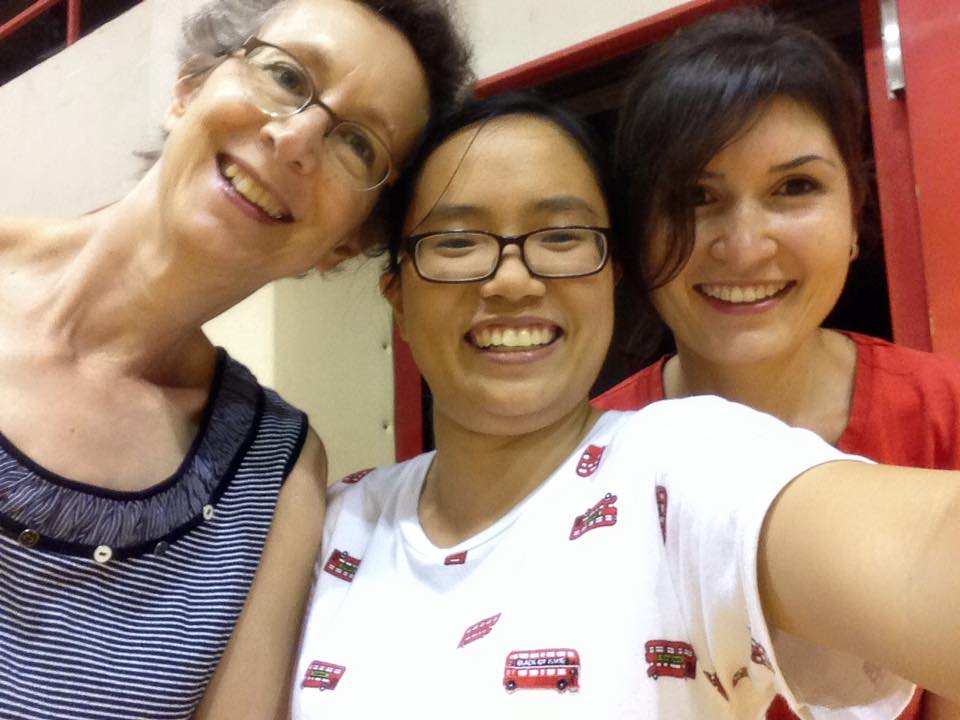
So it’s been something like that this week for me. Here’s a shot of two of my favorite students, Thu and Dinara, after the final Zumba workout on Monday last:

Sweet peas

Sweet peas

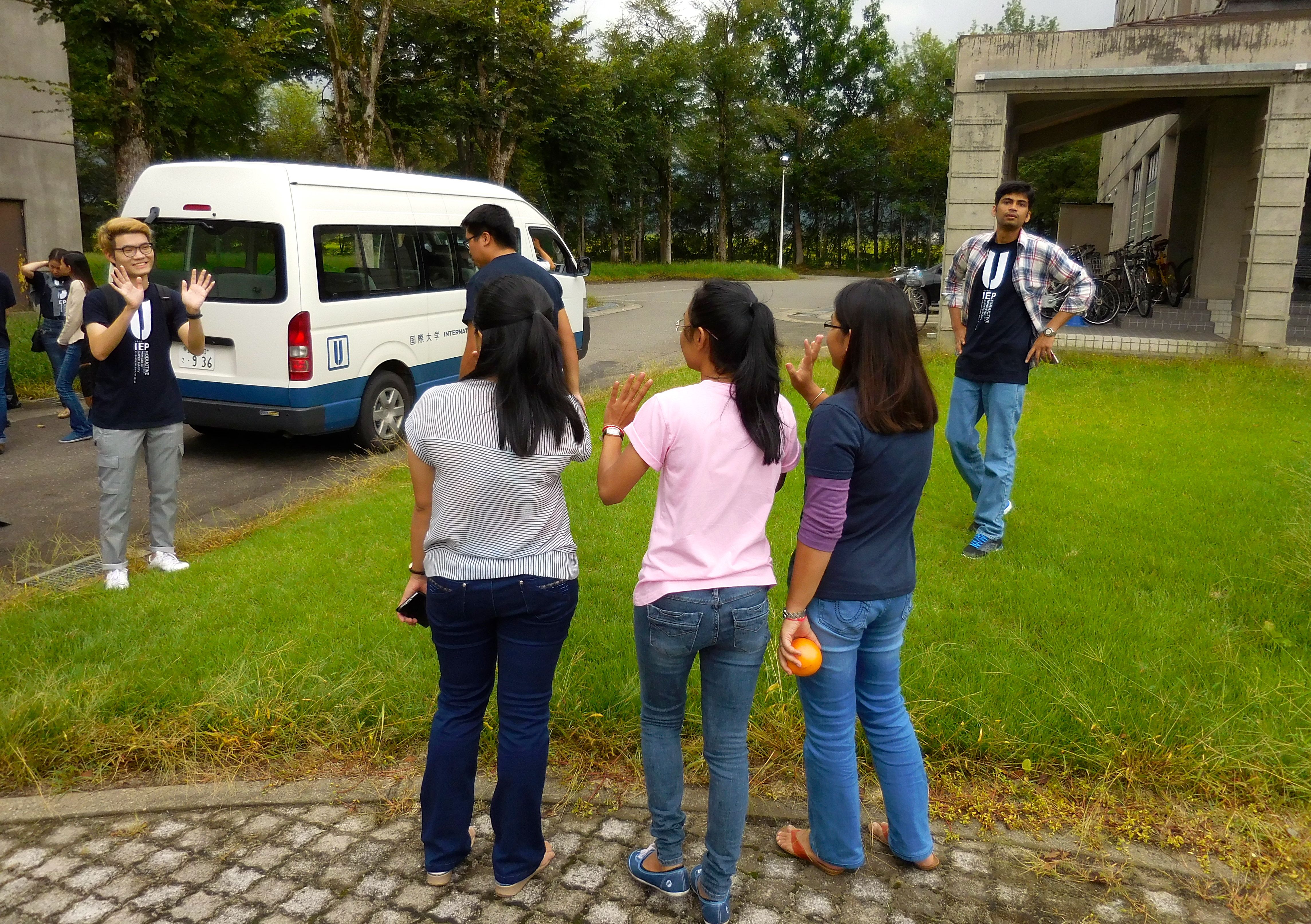
…then the departure on Wednesday of the IMF students headed to programs at the University of Tokyo that start earlier than other universities:

So long, but not goodbye

So long, but not goodbye

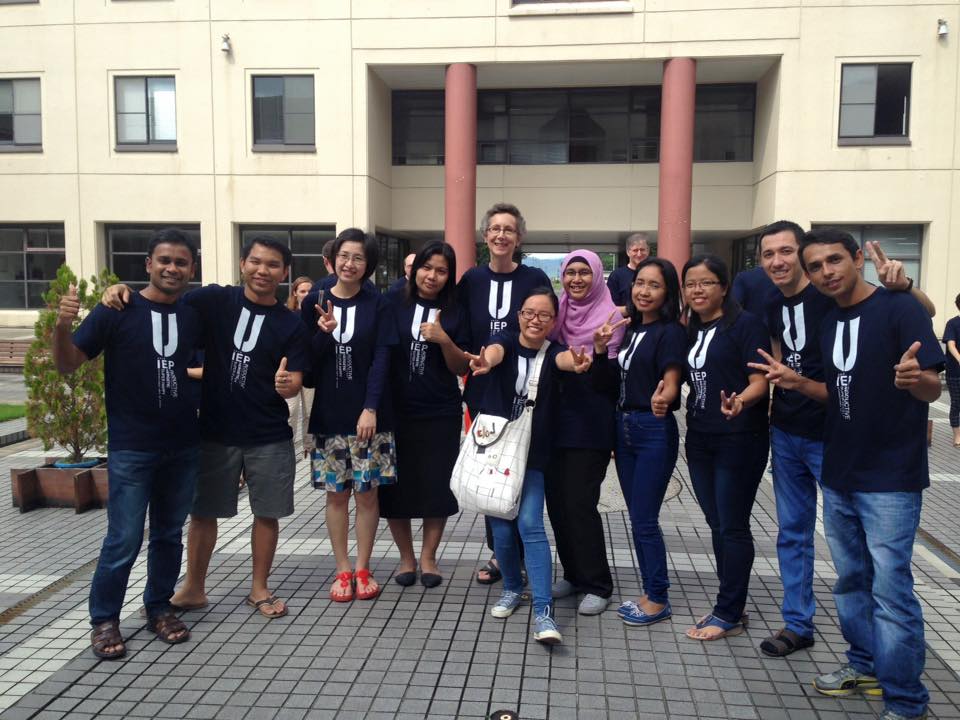
Things really kicked into gear on Friday when the formalities of departure took on a life of their own. First was the multiple photo sessions of each and every class that was held during the term, plus many other combinations and permutations – all women, all men, all teachers, Zumba class, running club, student leaders, faculty members, etc. This is a shot of my amazing IMF students from Phase 1, minus the ones who had left already in the van above:

World savers

World savers

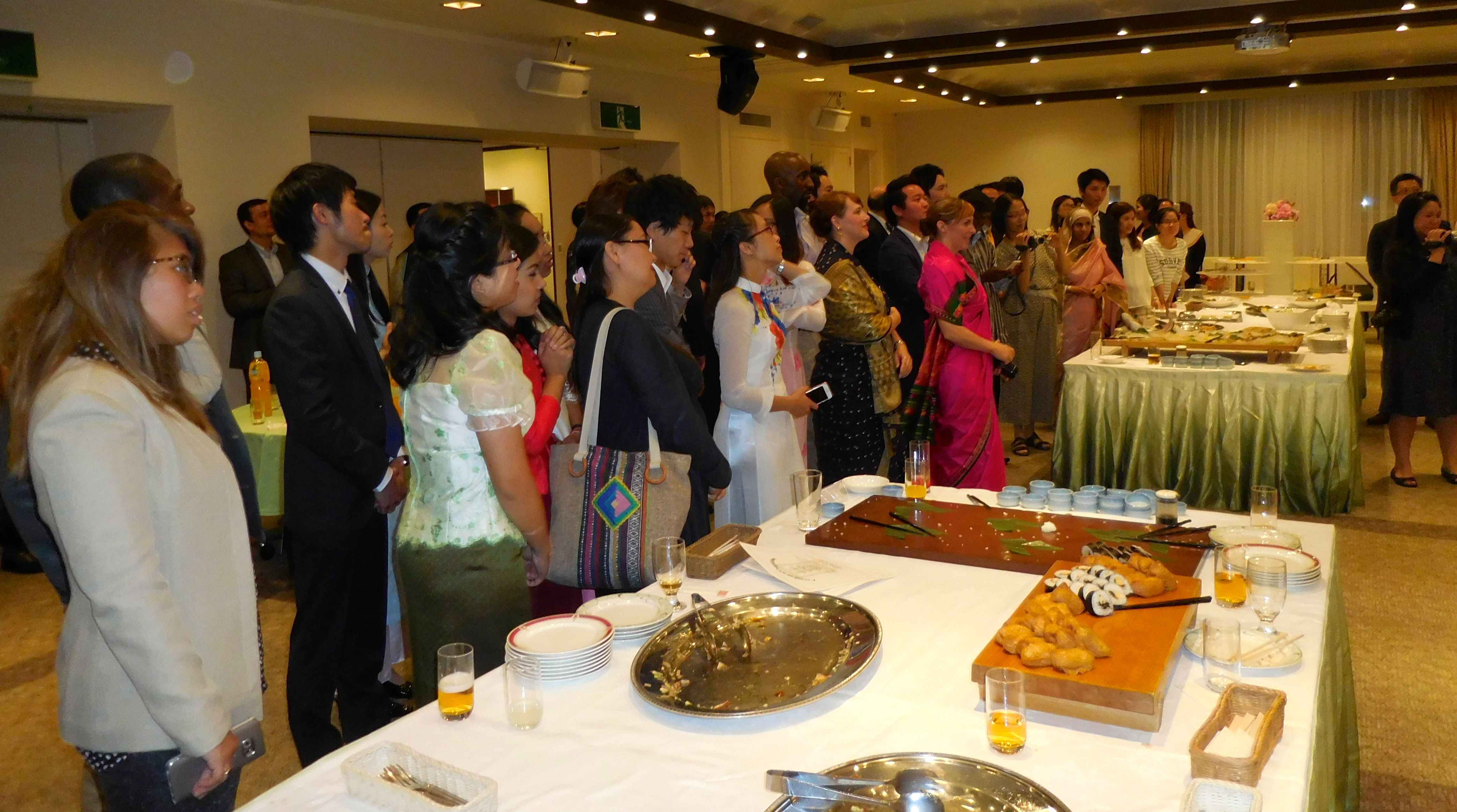
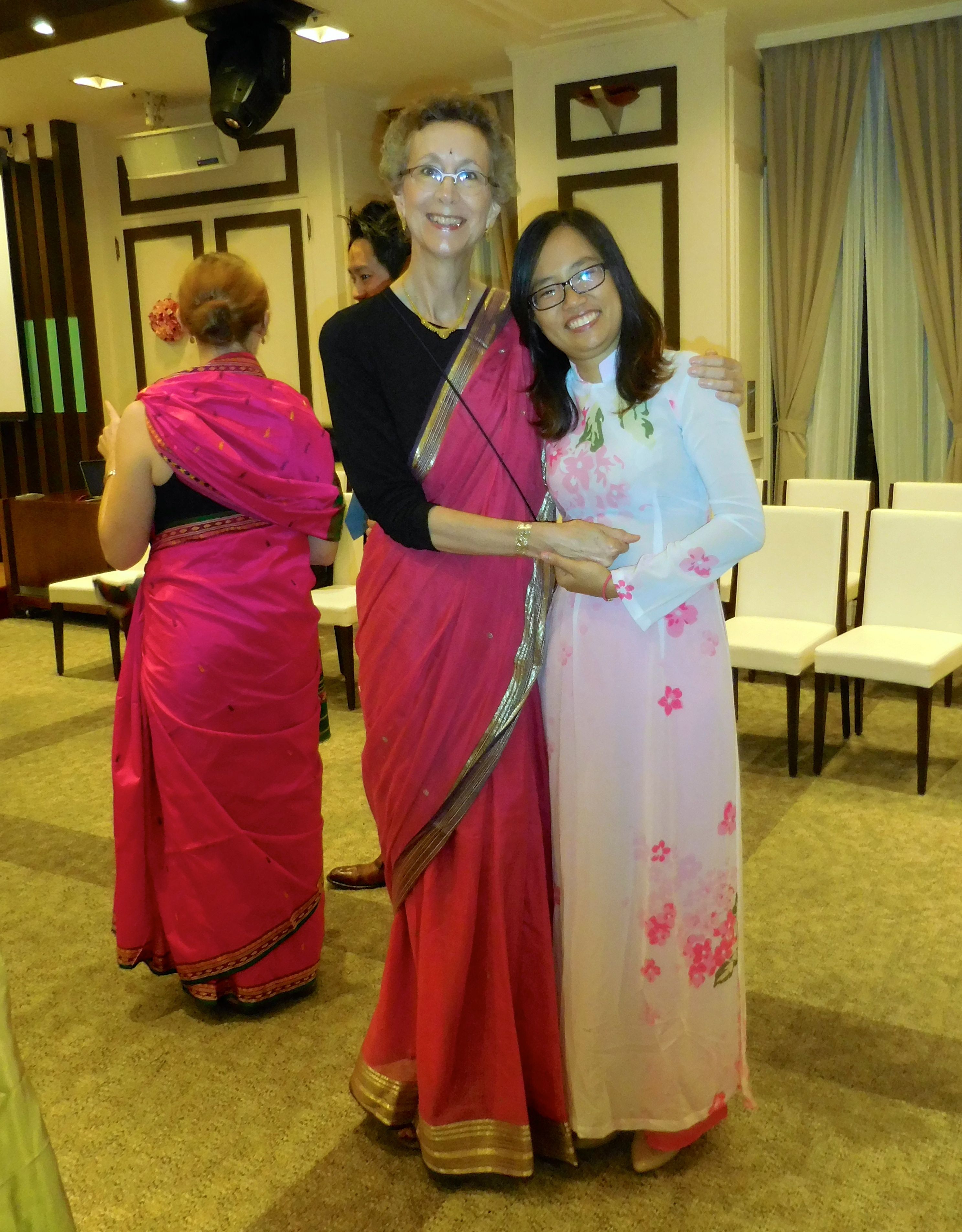
That evening was the official end-of-program bash, held at a local hotel and featuring a groaning buffet of local specialties.  As part of the fun, one of the full-time faculty wives shared some of her beautiful saris with the visiting female faculty members, and five of us headed off to the party looking like Bangladeshi princesses, complete with gold jewelry and even stick-on glitter and tattoos. Here I am in my regalia, again with Thu, near Rachel in the background:

Al gussied up.

All gussied up.

…a shot of the crowd as we begin the formal portion of the proceedings and and what’s left of the buffet:

The table was bare...

The table was bare…

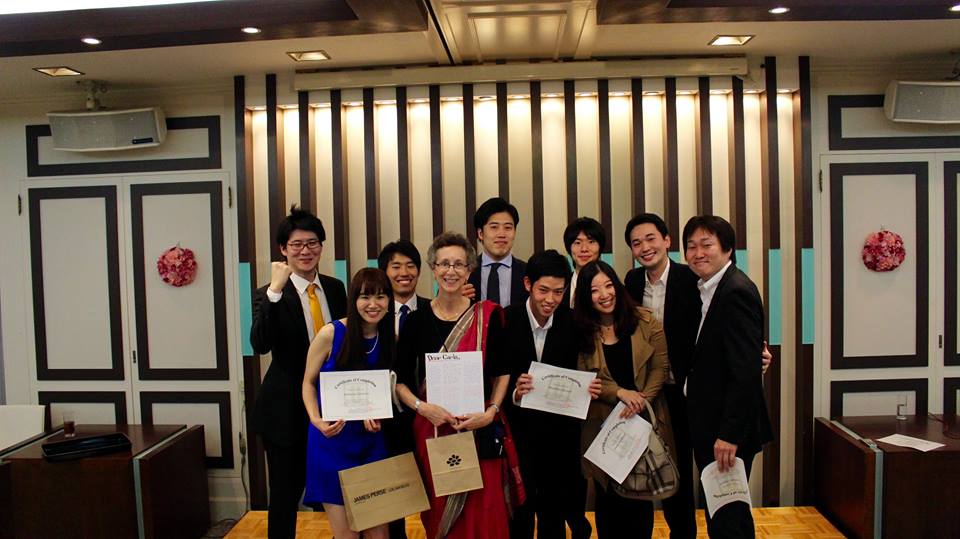
…the bestowing of certificates…

Oku hams it up

Oku hams it up after receiving his from Richard

…and a shot of my colleague Rob, the other “newbie” in Text Skills, who was my reality check during the summer. He actually swapped out his red tennies for the occasion.

Wry Brit

Dislikes being photographed as much as I do

There was a second party AFTER this, which ran until 2:00 am or so (I chose not to go, although I heard it was fun), and then a party AFTER that, which is just how Japanese roll. Still some stalwarts were at the bus stop Saturday a.m. at 7:55, ready to catch the shuttle to the train to the subway to return to their lives or to grab a bit of vaca before graduate school begins in earnest in a couple weeks. The place is moribund at the moment, filled only with the drone of lawnmowers and industrious representatives of the fire department checking alarms across campus, all in preparation for the beginning of the fall term, just around the corner.

Here’s a shot of my Text Skills class for the final four weeks. Such a lovely group of folks:

No dangling modifiers in sight.

No dangling modifiers in sight.

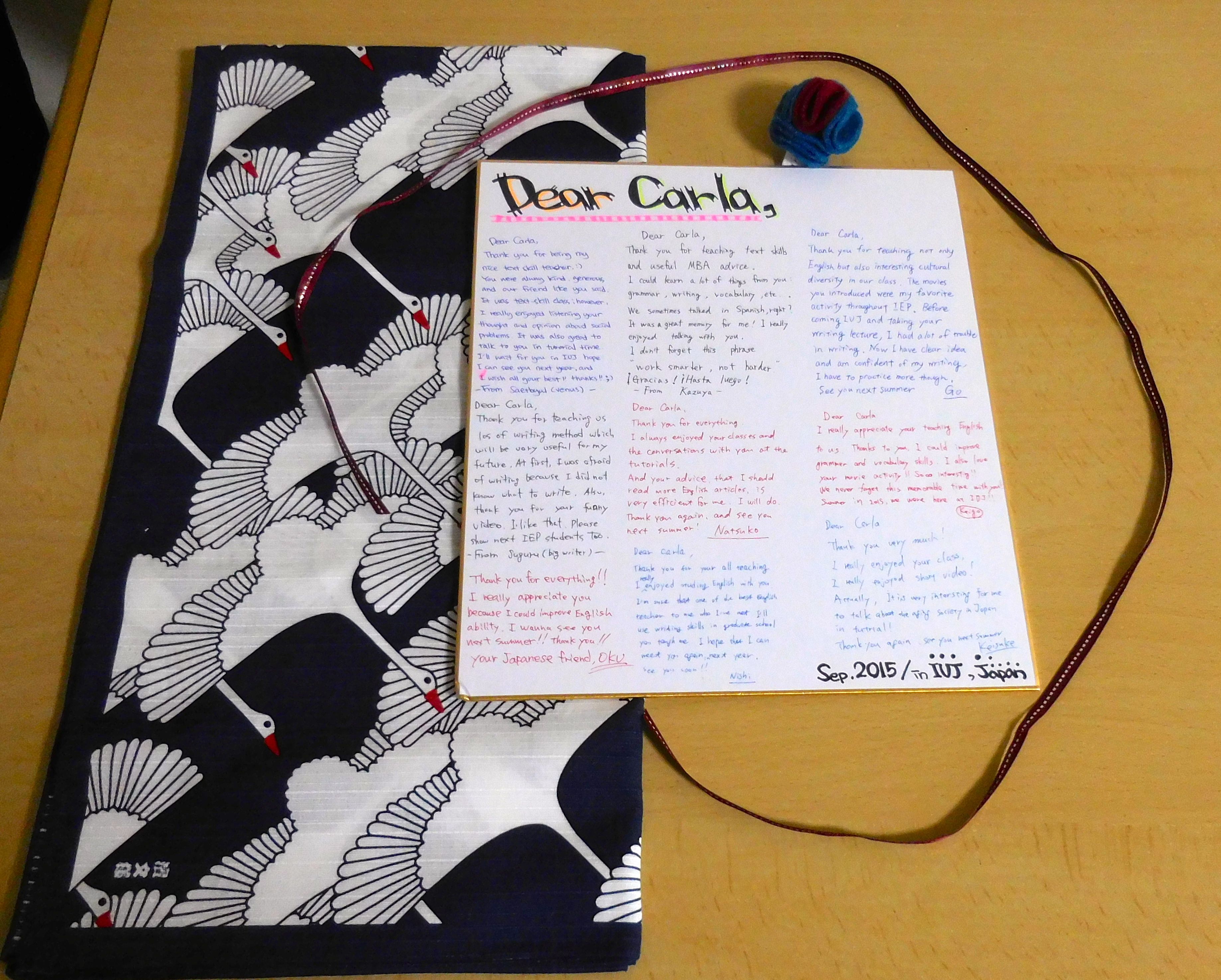
One last poignant shot – my very own “To Sir with Love” gift (a lovely crane tablecloth) with a heartfelt note from every member of the class you see above:

Will be treasured

Will be treasured

“The time has come…
For closing books
And long last looks must end
And as I leave I know that I am leaving my best friend
A friend who taught me right from wrong
And weak from strong that’s a lot to learn
What can I give you in return?
If you wanted the moon
I would try to make a start but I
Would rather you let me give my heart
To sir with love.”

On that note, filled with memories and gratitude for an amazing experience in the rice paddies of Niigata, I bid farewell to a remarkable group of students and colleagues at IUJ.

Posted in Teaching in Japan | Tagged , | 3 Comments

A trip to the sake brewery

We are in the waning days of my time at IUJ. The temperature has dropped into the reasonable range, the trees are beginning to show bits of color, and the rice fields have morphed slowly from the verdant young green sprigs of summer to the gold-tinged heads of autumn.

Waves of grain

Waves of grain

This region of Japan is known for a premier variety of rice, koshihikari, as well as its lovely byproduct, sake. Through some kind of longstanding faculty-alumni legerdemain, the members of our summer English teaching staff are treated annually, it appears, to a trip to a local brewery and a shared no-host dinner thereafter at which we can avail ourselves to seemingly bottomless bottles of the local vintage, courtesy of two IUJ grads. I was more than delighted to partake of this long-standing tradition, and so last Saturday afternoon off we went.

Sake, the national beverage of Japan, dates back at least to the time of Christ and probably before, coming as many things do around here from an earlier Chinese tradition. The distillation process is complicated and its explanation is better left to the experts, but the relevant bits are that there are many many varieties of sake in Japan and it is an honorable and respected part of the culture and national life. In terms of its punch, sake (which actually translates as “alcoholic beverage;” the drink itself is known as “nihonshu,” or Japanese liquor) has about twice the alcohol of wine (running roughly 18-20 percent), but considerably less than our Western distilled spirits such as vodka and scotch. (I was warned to watch my consumption, and I did. That being said, there is no shame in Japan that accompanies serious inebriation.)

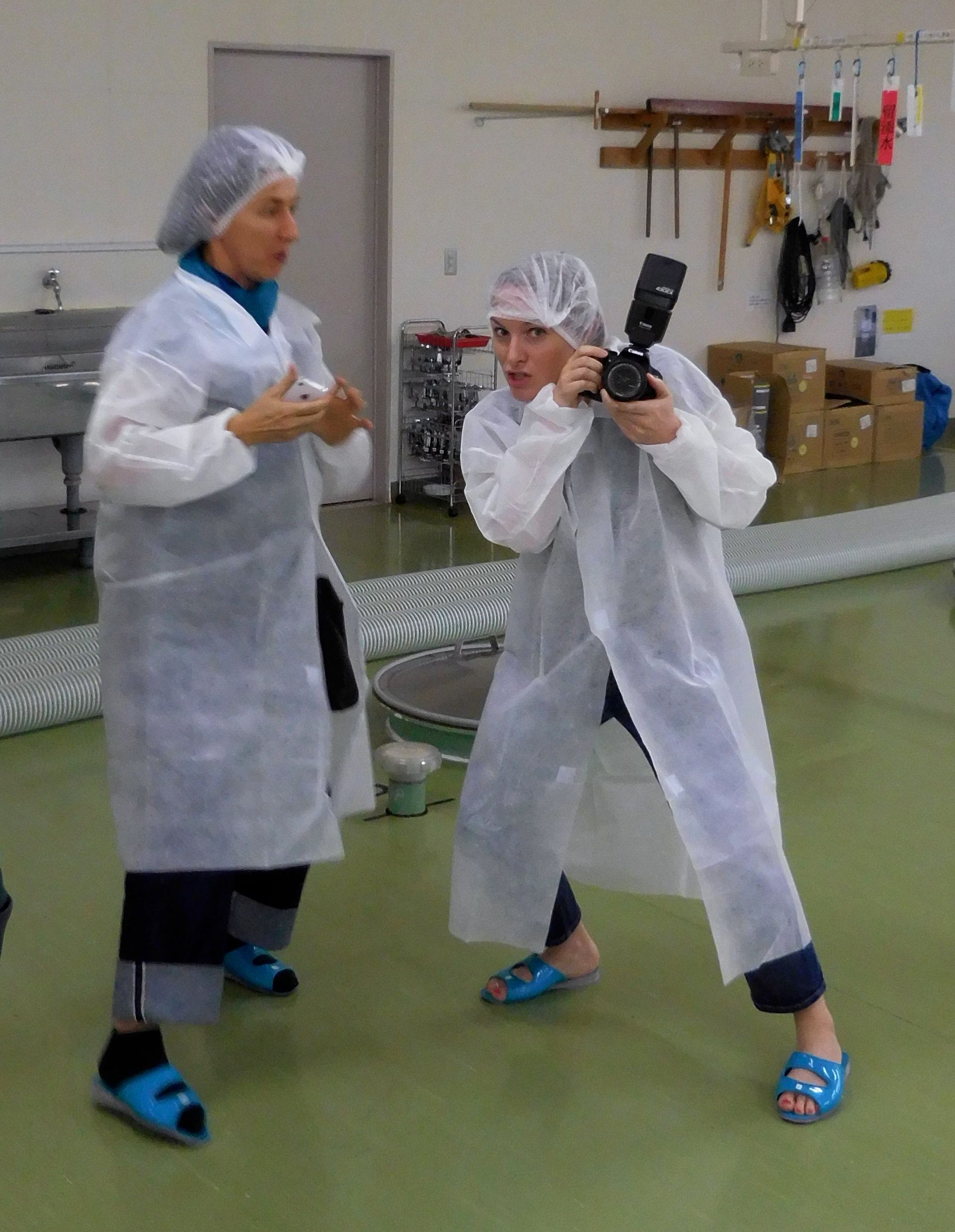
So, officially suited and sanitized, the faculty crew embarked upon our visitation to the brewery:

No contamination allowed

No contamination allowed

The tour took about an hour and required three different sets of foot ware. We went up and down sets of stairs, we went into cool cellars and hot drying rooms, and we peered at a lot of incomprehensible machinery, all duly explained in the Emperor’s Japanese. I just looked for interested camera angles, and came up with a few.

Here’s the thresher or the separator or whatever the thing is that sorts through the rice:

Ouch

Ouch

and then below it, the obligatory Japanese warning sign:

Don't touch, grasshopper

Don’t touch, grasshopper

I was charmed that this brewery managed to blend its new equipment with a reminder, still standing in the back, of the earlier machinery that had brought this brand to greatness:

Honoring the past

Honoring the past

Of course there was the obligatory “oooh” and “aaah” over the size of the tanks and the appreciation of what is going on inside:

May I have a big straw, please?

May I have a big straw, please?

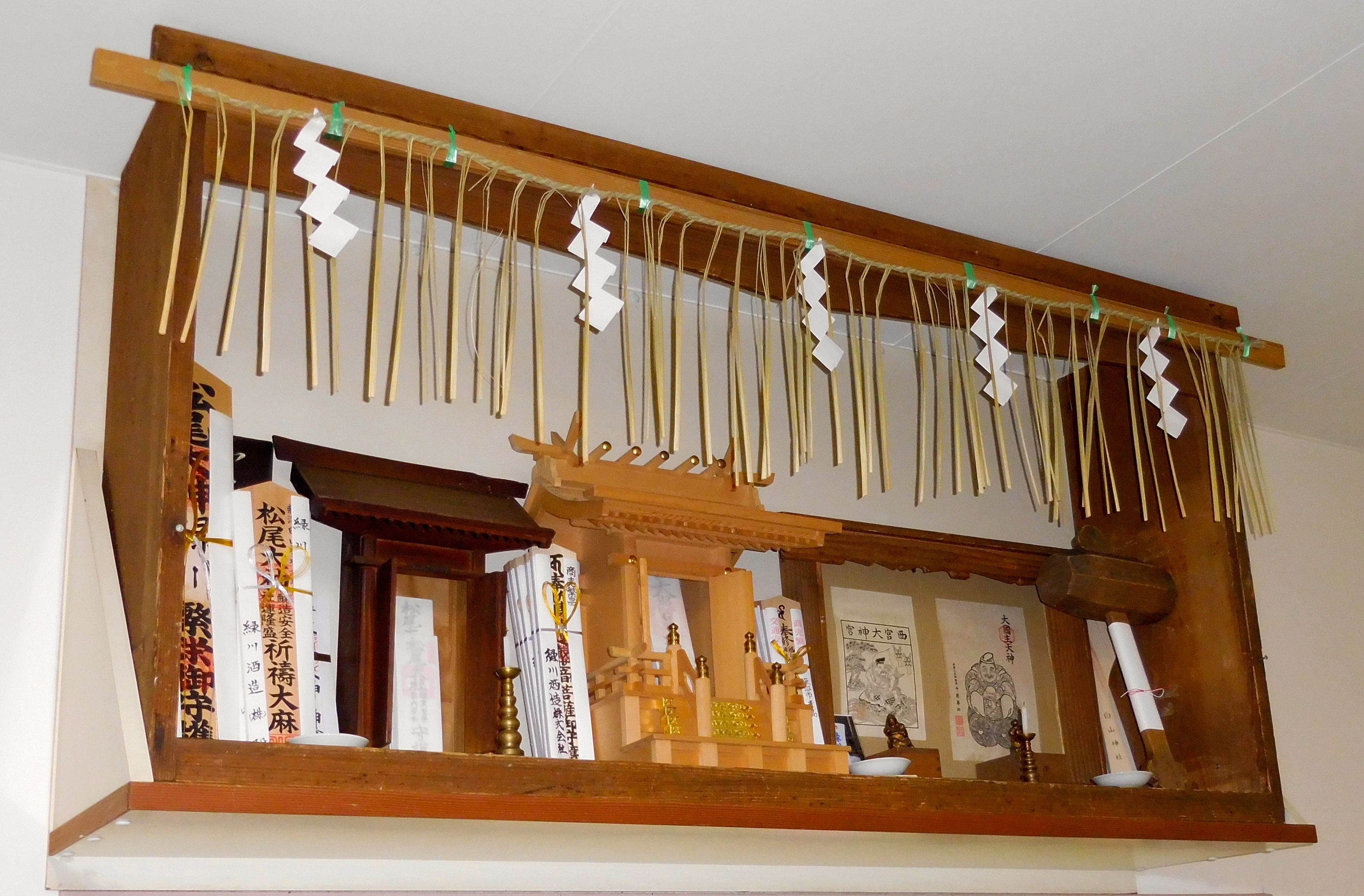
I was particularly charmed by the little shrine built into the very wall of the brewery, over an entrance into one of the larger rooms. The figures and small pieces of paper indicate hopes for good harvest, a good production year, and overall general prosperity for the organization and its employees. The Shinto tradition is alive and well.

Oh, God, please let the harvest be good.

All best wishes

About this time our collective attention began to lag, particularly since there didn’t seem to be any samples forthcoming, so instead of listening closely to the particulars of the latter parts of the tour, some members of our creative and resourceful posse began resorting to funny poses:

Gretchen and Rachel mug for the other camera

Rachel mugs for the OTHER camera

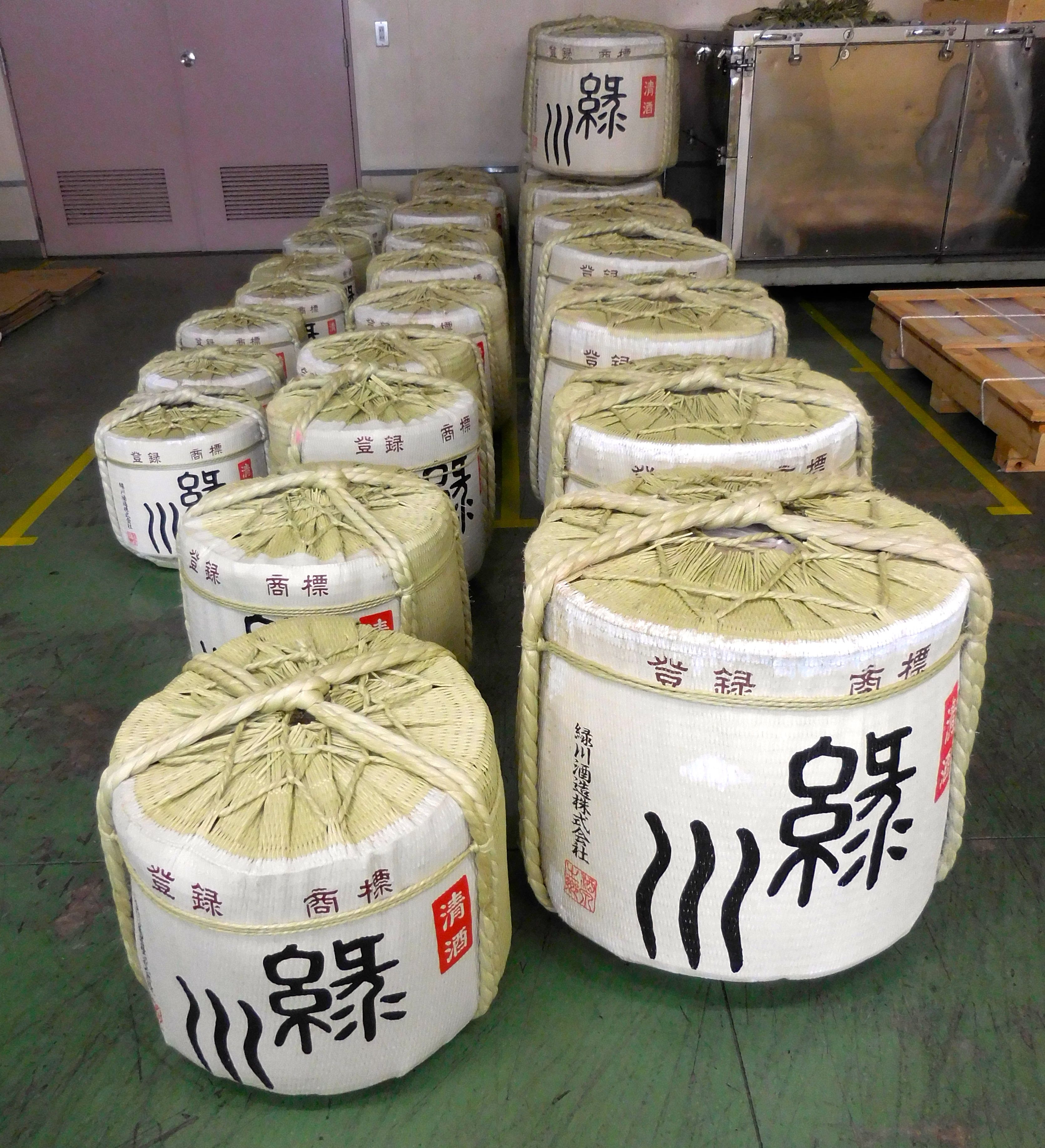
Ahem. Finally, once the sake has been brewed to perfection, it goes to age in these charming barrels which have been designed to look exactly like those from the days of yore. We were a little discomfited to learn these were, underneath the cool wrapping paper, made of stogy styrofoam:

Ready for the next festival

Ready for the next festival

Okay. Enough science. Time for chow. A little distance away, a lovely restaurant in the village of Koide had been working feverishly all afternoon on our behalf. We were greeted with this offering and dug in with great enthusiasm:

Skip the whale. I should have.

Skip the whale. I should have.

Much to our surprise, shortly after we arrived the president of the brewery showed up to join us for dinner. He sat at my end of the table, and after his numerous protestations about his bad English, we had a marvelous conversation about the sake industry, his children studying in the UK, and the differences between Japanese and foreign workers. He has a serious academic background in organic chemistry and worked for many years at Suntory, one of the largest makers of distilled beverages in the world, before coming to run this operation. I was honored to make his acquaintance, and he said he would try to come join my class next summer.

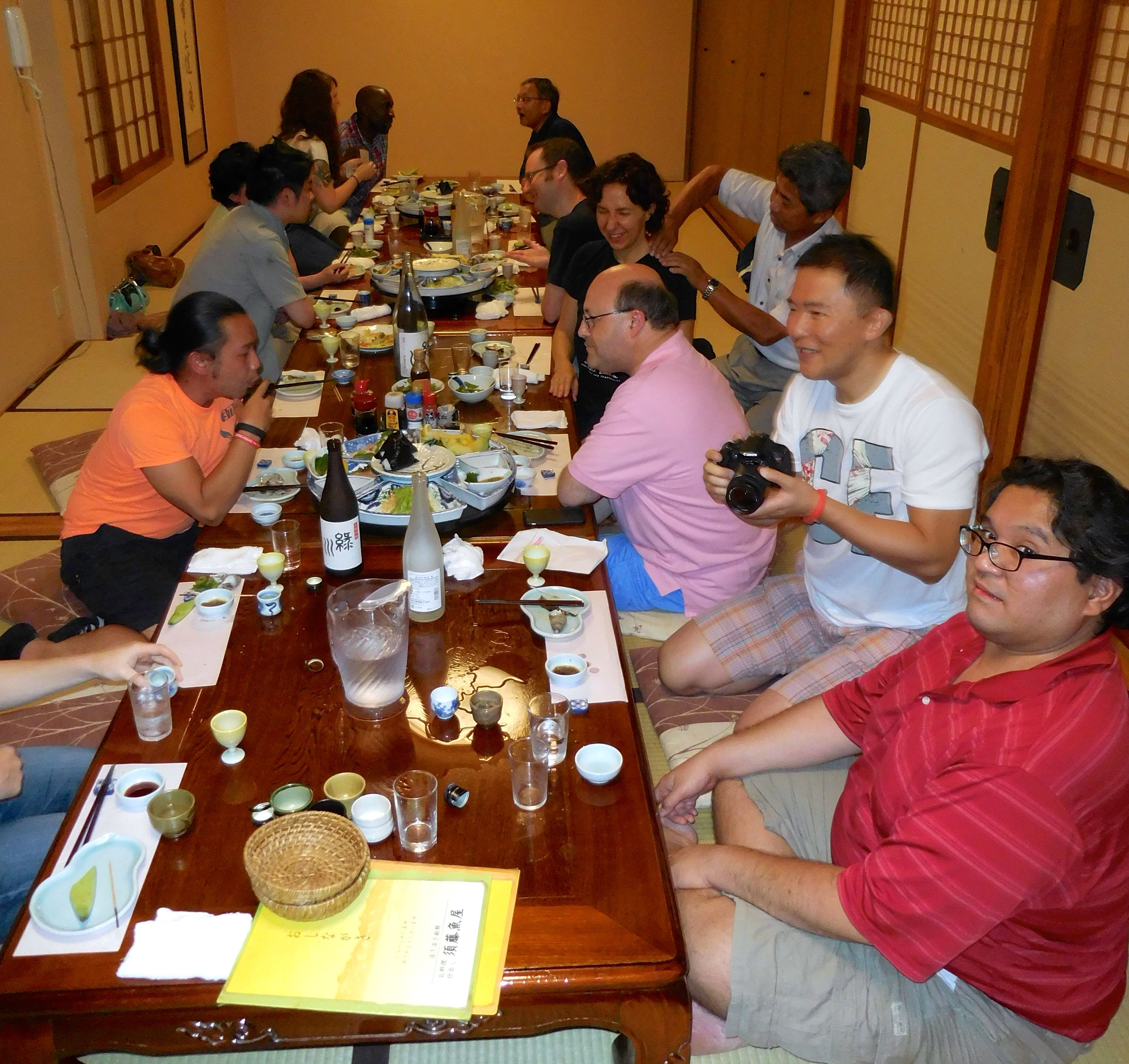
Here’s a shot of the happy diners, just about the time things got rowdy. The president is at the back, on the right. You’ll note that another brewery employee, truly committed to total customer satisfaction, is in the process of giving Gretchen a shoulder massage. (I didn’t manage to catch his attention, but not for lack of trying.)

Japanese hospitality par excellence

Japanese hospitality par excellence

You’ll also note that we were sitting on the floor all night, cushioned only by thin mats in the traditional manner. I took great pride in the fact that I squirmed far less over the course of the evening (some three or four hours) than my considerably younger colleagues. We are so pampered in the West.

So there you have it. A lovely outing, a delicious dinner and a wonderful look into this most ancient and honorable Japanese beverage. Kampai!

Posted in Travel - Japan | Tagged , | 4 Comments