Carla’s Top Travel Tips

Caveat: no pictures, no history, no culture, just a bunch of ways to save a buck or drachma.

As a college freshman, expecting to become either the Secretary General of the United Nations or the NBC Bureau Chief in Moscow, I chose Russian to fulfill my foreign language requirement. That fall, the 8:00 am section was taught by Gospozha (Mrs.) Pavlova. Her first name, Galina (Hope), seemed an odd mismatch to the stocky, sturdily built, unsmiling, and steel-tempered matron who stood before us five days a week and terrorized us into learning the myriad conjugations and declensions required to even begin mastering that tongue. Knowing a little college Russian turned out to be a godsend in Georgia, where most of the 30+ crowd spoke it about as well as I did, and it became a clumsy but helpful lingua franca, far preferable to the completely unintelligible local language of ქართული, known there as Kartuli, not Georgian.

время – деньги (vremenya denyegi) or “Time is money,” Gospozha Pavlova used to repeat to us sternly, usually when someone was stumbling over a translation or momentarily frozen into incoherence. Attributed to Benjamin Franklin, it seemed an odd expression extolled by a person raised in the Soviet Union, but it has stuck with me as a useful phrase nonetheless, and it is the theme of today’s blog entry.

As is clear from the postings of the last couple years, I have been doing a lot of traveling. A LOT. And, while it hasn’t been cheap, I have been fairly clever and thrifty in how I travel, hence my ability to do more of it. Newly back from my latest jaunt, and while these ideas are still fresh in my mind, I thought I would share some of the ways I save money on some things so I can spend it frivolously on others.

The important thing to emphasize is that – saving money when you travel is 1.) a matter of doing  your homework and 2.) being willing to give up a little (a little) of the security of a travel agent, a tour group, or a Eurail pass. But if you are interested and able to do the work, you will be astonished at how much you can save without sacrificing on comfort, safety, or fun. So here we go. Caveat: most of this information I have gleaned from travel in the US or Europe; there may be other competing philosophies for other parts of the world of which I am not aware.

Plane tickets

Clearly one of the biggest ticket items in any travel budget, plane tickets today are curious beasts and require a bit of study. There are two philosophies. One is to become a frequent flyer of one particular airline or airline group. If you fly enough and long enough, this can benefit you through upgrades and lots of other benefits. But this requires consistency and patience. Those miles add up; but it takes a lot of them to really help. The other way is to learn about the different airlines out there and have a little flexibility, if you can, about when you travel and how much time you are willing to spend en route.

There are a lot of online resources for plane tickets – Expedia, Kayak, Hipmunk, and so forth. I like and have used Expedia for some time now – my main reason is their customer service. It is good and they will solve your problem, even if it takes an hour and a half. The customer service desk is in Manila (or was, last time I called), but it is a 1-800 number from the States. In my experience, prices are as low or lower on Expedia than other sites I have checked; anyway, they are my go-to for planes and sometimes hotels. I use both the airline websites AND the consolidator sites (Expedia) for planning trips.

Plane ticket prices vary by season; higher in the summer, usually. Some airlines have very useful pages on their sites where you can see at a glance the different prices for different days. If you crawl around the airline websites, you can often find these pages. As of today, Wow Airlines offers a flight from Boston to Amsterdam (one way) for 330 USD in June; 149 USD in September. Days of the week even in a single month can vary wildly. Wow, again, has that 149 USD price on three Sundays on September, but the price is 445 USD for the 15th and the 17th. So, as you can see, lots of volatility.

Then there is the whole issue of when to buy. In my experience, there are two “sweet spots” for plane tickets – six months out, and two months out. In my life, I don’t usually plan things too far in advance, so that two month window has worked very well for me. After that, prices can go up precipitously.

Finally, there’s the “budget airline” question. As we all know, plane flight, once romantic and glamorous, is now basically a practicum in Zen meditation conducted in a sardine can. (Can I stay focused on my book for three more hours while that child behind me screeches at the top of her lungs and monotonously kicks the back of my seat? Can I both stay sufficiently hydrated AND not have to climb over two heavily sedated people to go to the loo every 45 minutes?Has the man in the seat in front of me HEARD of deodorant?)

But budget airlines come with their own additional hidden agendas. On Turkish Airlines (one of my favorites – still feeds you and gives you movies for free at a decent ticket fare) the carry-on allowance is 8 kilos, about 17 pounds. On Wow Airlines (no movies, no food except for purchase), the carry-on allowance is 5 kilos, about 11 pounds, and you have to pay 39 USD extra *for each segment* if your carry-on is heavier than that (as of today – it was 24 USD when I traveled in May). There is also a charge for checked luggage, all charges cheaper if done online than in person. So, for a Boston-Amsterdam flight, for example, there are four segments (to Iceland, to Amsterdam, from Amsterdam, from Iceland), and that’s an additional ~140 USD, just for a bigger carry-on (in this case, 12 kilos, about 26 pounds). Ryan Air is infamous for hidden fees, so if you travel one of the known budget carriers, be sure to take a little time to read the website and the user reviews so you’re not in for serious sticker shock at check-in, a bad way to start a trip. Here’s the link for WOW, just so you can get your bearings:

http://wowair.us/travel-info/fees-charges/

Accommodations

In this ear of Couchsurfing and Air B&B, I’m still a hotel girl, so you have to accept that as my biases. Frankly, I don’t like having house guests overly much, nor do I like being one, but lots of folks have had excellent experiences with these organizations, and I would encourage you to do your own personal due diligence in this regard. Why do I like hotels (well, good hotels)? They’re clean, they’re impersonal (I don’t have to make pleasant chatter in the morning before coffee), they have a front desk staff that’s usually very friendly and helpful, and, when I do it right, they have a big breakfast and free internet.

Again, lots of research goes into my hotel selection, and I don’t always get it right, even with all that. Like plane flights, hotel prices vary A LOT, day to day, week to week, month to month. The big difference between using a hotel website to make your reservations as opposed to a site like Expedia or booking.com is that if you book through the hotel’s website, you have a better chance of getting an upgrade and other perks. If you use the consolidators, you run the risk of getting of the the “dog” rooms (I’ve been under the eaves, subject to hot afternoon sun, forced to listen to the S-bahn line, crouched under shower heads). But I have gotten them through the consolidators at very affordable prices, sometimes significantly so. And of course I don’t always get the dogs, but this is the risk.

What Expedia does that I find helpful, is have weekly deals on different hotels, and those deals move around at random. Once you type in your dates and get a list of potential hotels, Expedia even has link for “best deals.”I compare those hotels with TripAdvisor’s evaluations, and then watch the hotels I like best for a while to see if I can get deals on them. My best score was K&K Central Hotel in Prague, where I had a fabulous room, bed, breakfast, location, and internet for about 65% less than the other consolidator websites *because I managed to book during one of the weekly deals.* I loved that room. Loved it. They had to drag me out kicking and screaming.

Watch carefully, though, for the notes in small print about breakfast. In every European hotel I’ve stayed in (and most other places), there is a buffet, from small to large, dull to imaginative, dismal to mouth-watering. I think the best was the Radisson Blu in Tbilisi, of all places. Anyhoo, if the breakfast is not included, you can almost always buy it on the spot, but the prices for these things can be outrageous (to my mind). 15 Euro is rock-bottom (about 17 USD), up to the breakfast served in Copenhagen this past week, 220 DKR or 33.50 USD per person for breakfast. (Yours truly usually finds a local coffee shop.) Other services, laundry, mini-bar, even the innocent water bottle on the nightstand, can also be prohibitive, so watch carefully.

Local transportation

I was armed and dangerous on my first trip to Europe – Eurail pass and youth hostel card. In those days, 350 USD bought you three months of continuous travel over what passed as Europe in those days – everything from East Germany, Czech Republic, Hungary, the Balkans to the East was verbotten, making the rail-accessible continent a smaller place than it is today. But it was a deal, and I used it well, days, nights, you name it.

Today I would use caution in buying a Eurail pass, particularly if you’ve passed the magic age of 26. What you get in ease of purchase and use — you pay for rather dearly in money and flexibility. Don’t get me wrong – I love trains. But to use the train system well, I recommend consulting Mark Smith, the man in seat 61, who basically knows all there is to know about train travel around the world, and from whom I have learned a great deal:

http://www.seat61.com/

BUT if you can tear yourself away from the allure of the rails, Murder on the Orient Express and all that jazz, I really recommend the buses these days. Cheaper, more frequent, more nimble than trains (they’re rarely late), buses are the way the young and thrifty travel. The stations are far less glamorous, but the buses themselves have been consistently for me clean, fast, equipped with refreshment and wifi. On long trips they break at nice rest stops where you can eat, use the facilities, buy goodies for the road, smoke, etc. I traveled around Poland for two weeks using only Polskibus and spent 25 USD TOTAL. That’s right. One four-hour leg of my journey was 1.75 USD. (I spent more on the cappuccino.) Now, most of the rest of Europe can’t match those prices, but you can do very well indeed. Again, day of the week and time of day figure into the prices, so keep that in mind. Flixbus in Germany is good, also Eurolines. There are others.

Parting shots: food, fun, restrooms

Okay, so I told you to take the bus, right? Now I’m going to tell you to GO to the train stations – for food. The bus station food is dreadful, but the train station food is great (in most major cities). Everything is less expensive than in restaurants, packaged to go, and, because there’s a lot of demand, relatively fresh. You can get organic stuff, gourmet stuff, and regular stuff, along with the regional specialties, coffee, and of course, Toblerone.

Facilities at bus and train stations vary widely. In Berlin, for example, the main bus station has restrooms that virtually sparkle – but you can’t count on that. My suggestions for clean restrooms on the go are department stores, museums, restaurants (if you are a patron, of course), and if you’re feeling particularly bold, luxury hotels. Yes. Just throw a scarf around your neck, ladies, freshen your lipstick, throw back your shoulders, stand tall, and walk right in. I personally have never been challenged and have carved my initials in some very lovely venues indeed. If you act like you belong there, you can usually get in and out without much fuss.

Finally, take some time when you are in a place to discover what’s free. Often museums have a free day (or time of day) and that can save you a lot. Consider, if available, a 72-hour pass that comes with reduced entrance fees or sometimes free entry to various attractions. During the summer months, there are lots of free concerts and festivals in many places. Your front desk staff, if you’re at a hotel, can be very useful and there are often free publications for the month or week that lay out more activities and entertainment than you can possible imagine. Alternatively, check TripAdvisor. There’s always a “Things to Do” section for every destination (many written by me at this point) that will point to to the “must sees” and may help you uncover something amazing you might otherwise have missed.

So there you have it – my collective travel wisdom of the moment. If you know differently or would like to add your thoughts (or have me include them), just let me know. I’ve really enjoyed figuring these money-saving measure out for myself, and I’m thrilled to know they might help someone else. Safe travels!


Posted in Travel - planes, Uncategorized | Tagged | 3 Comments

Scenes from the street

Besides feverishly studying German (ahem), many of my waking hours here in Berlin were spent, er, walking the streets. As you’ve probably surmised, I love walking in general, but on wide, well-maintained urban sidewalks with little to no elevation through multiple European fascinating neighborhoods – well, that’s just my version of a controlled substance, and I’ve been indulging at every opportunity.

The English writer Aldous Huxley once described Los Angeles as “72 suburbs in search of a city,” a statement which continues to be an apt description of that sprawling megalopolis, but a similar concept, albeit containing a lower number, could also be used to describe Berlin. For many years there were 20 “boroughs” in Berlin, but with some administrative reform after the city’s reunification, there are now 12. Each and every one of them, particularly those which were paired *simply because they were so different,* has its own unique personality and slavish following. Like Portland, Oregon, where I spent many years, people tend to identify as much by their borough as the larger metropolis itself, and most of us have favorites.

As a result, an afternoon’s ramble could roam through two or three of these area, from the quiet residential neighborhoods of Charlottenburg to the popular tourists spots in Prenzlauer Berg; from grungy streets with wall-to-wall outdoor cafes covered in graffiti in Kreutzburg to huge governmental or commercial office buildings on stately boulevards in Mitte. And while it’s simply impossible to put much of this into a blog post, today I though I would focus on some of the more off-beat elements I have seen on my rambles over the past month or so. There’s no real story here or much coherence at all; just a lot of shots that explain my love affair with Berlin that I wanted to share with you.

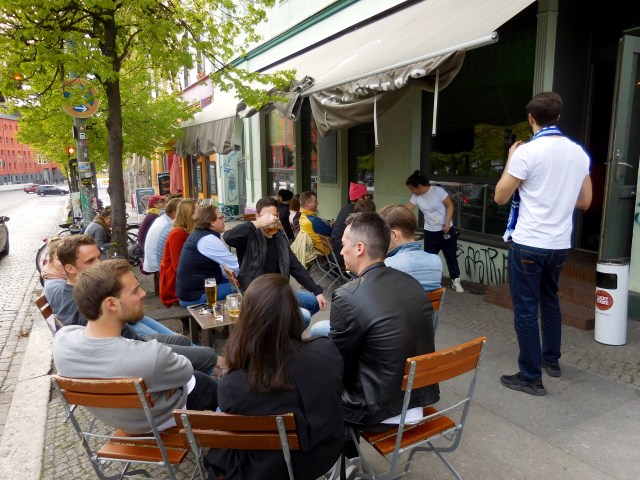
Let’s start with cafes. Since the first several times I traveled here the climate was less than hospitable, I hadn’t seen the way that social life literally tumbles out onto the streets with the advent of warm weather, outdoor cafes sprouting like dandelions along many side streets.  Here’s just one exemplar of literally hundreds, if not thousands, of these inviting venues:

Berlin - cafe

Watching the game through the window…

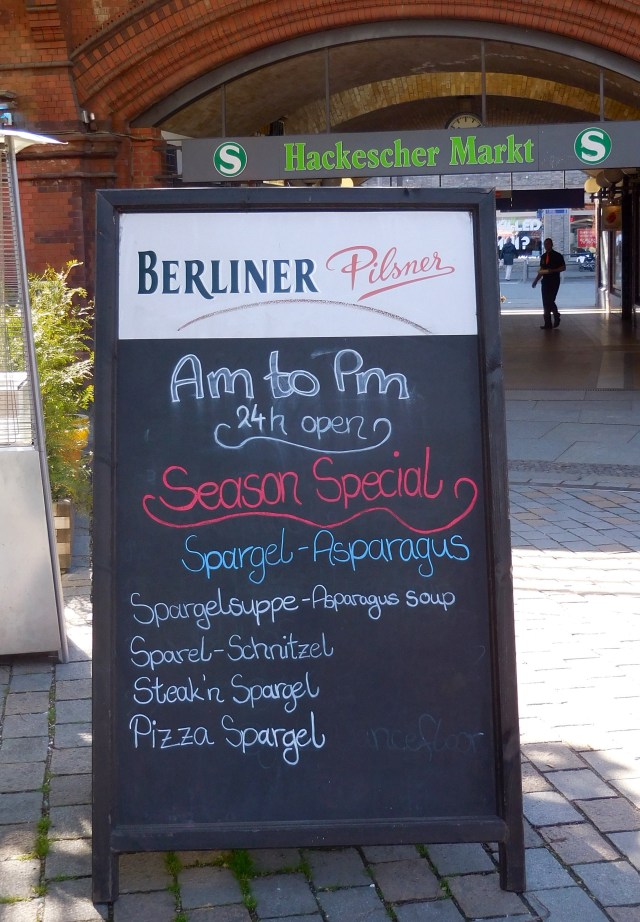
…and in the cafes, food and drink abound, of course, to say nothing of spirited conversation, family life, and the occasional sizzling romance. Ambiance aside, the spring months herald a kind of gourmet madness in Berlin – the advent and mass consumption of Spargel (asparagus). And not just any asparagus, mind you, but the big white ones, a variety I have never seen (or noticed, at least) in the US. They’ve been on the menu continuously during my stay in town, available in some shape or other for breakfast, lunch, or dinner. Here’s a sample menu just to whet your appetite:

Berlin - spargel

Waiting for the spargel sorbet…

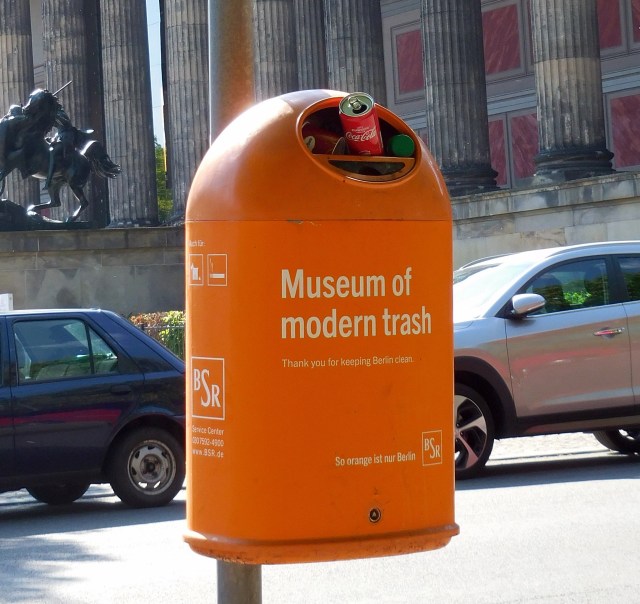
Moving along to some of the quirky and wonderful sights that have cheered my days…. On Museum Island, near the amazing collection of art galleries assembled there featuring some of the wonders of ancient and modern civilization (you see the columns of the Altes Museum in the background), one finds this welcoming receptacle:

Berlin - modern trash

Create art here

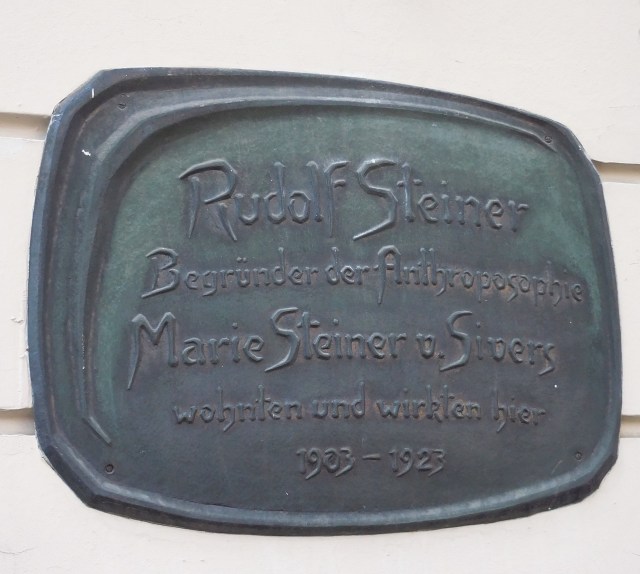
In the Nollendorfplatz area, known as Berlin’s Boys Town, next door to a bona fide ‘leather’ store, I found evidence that the famous author, philosopher, spiritualist and esthetic Rudolf Steiner had lived in the neighborhood for some years with his second wife:

Berlin - Rudolf Steiner

Budding Theosophists welcome

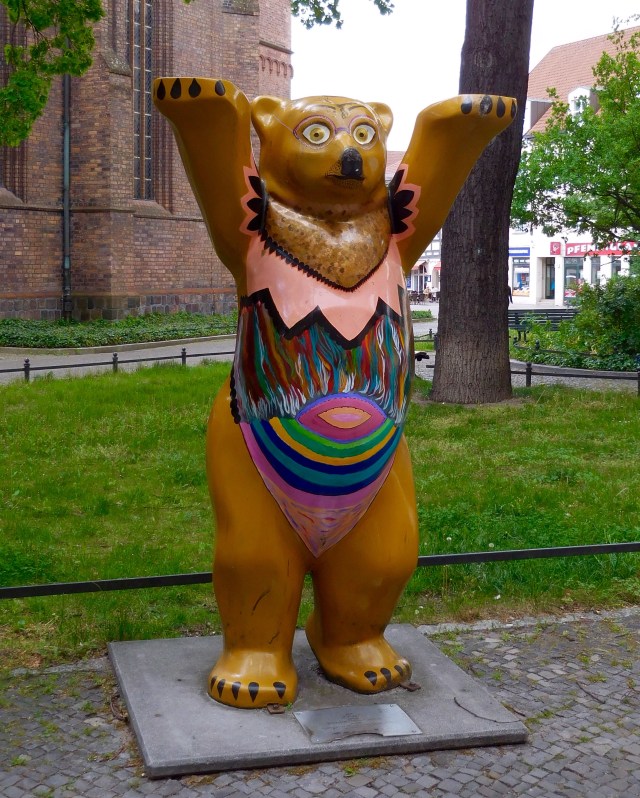
Ya never know. The juxtapositions and contradictions abound. In another example, here and there around town are currently a set of oddly dressed “buddy” bears (the bear being the symbol of Berlin, as it is of Bern, Switzerland, as well). The entire set numbers around 100; this particular one stands in front of an historic evangelical church in Spandau – an quirky pairing, to my mind:

Berlin - bear in tutu

Barely there

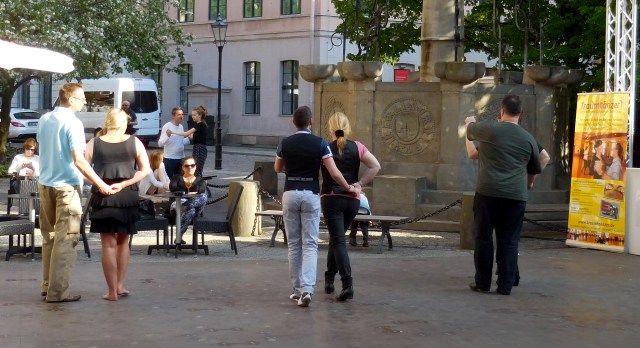
…and in another historic neighborhood, this one the Nikolaiviertel, the reconstructed heart of the 13th century medieval town square, one sees an evening tango lesson. According to one of my teachers, Berlin is mad for tango. Who knew?

Berlin - tango

“Left forward, RIGHT back…”

My friend Kurt, an expert on travel and tourism, says that one of the big allures of Berlin is what he calls “dark tourism,” the fact that Berlin “leans in” to its long and difficult history. (Imagine if the US had a “Museum of Slavery,” for example, or a “Memorial to the Native American Genocide”). In a small example of that spirit, here’s a poster on a fence outside a small boxing gym, commemorating the life of a young Sinti (a Roma people) boxer, Johann Trollman, who should have won the German light-weight title in 1933 but didn’t due to the strict Aryan laws. Imprisoned for his racial impurity, he died at the hand of someone he had bested in an informal camp match. His title was retrospectively recognized and awarded in 2003:

Berlin - Sinti boxer

Fighting for recognition

As a result of those “dark times,” people tell me Germans in general – and Berliners in particular – are very serious about their demonstrations, always ready to give the government and the press a piece of their mind. When I was in Dresden, I saw the exhibit of the “returning wolves,” a protest against the neo-Nazi demonstrations that occur every Monday there. The neo-Nazis are here as well, but the counter-protesters outnumber them by so many orders of magnitude it barely matters. I happened to stumble into a march early in my stay – I was happy to see so much positive activity against racism and so much evidence for an open and welcoming city:

No No Na-nazi..

No No Na-Nazi..

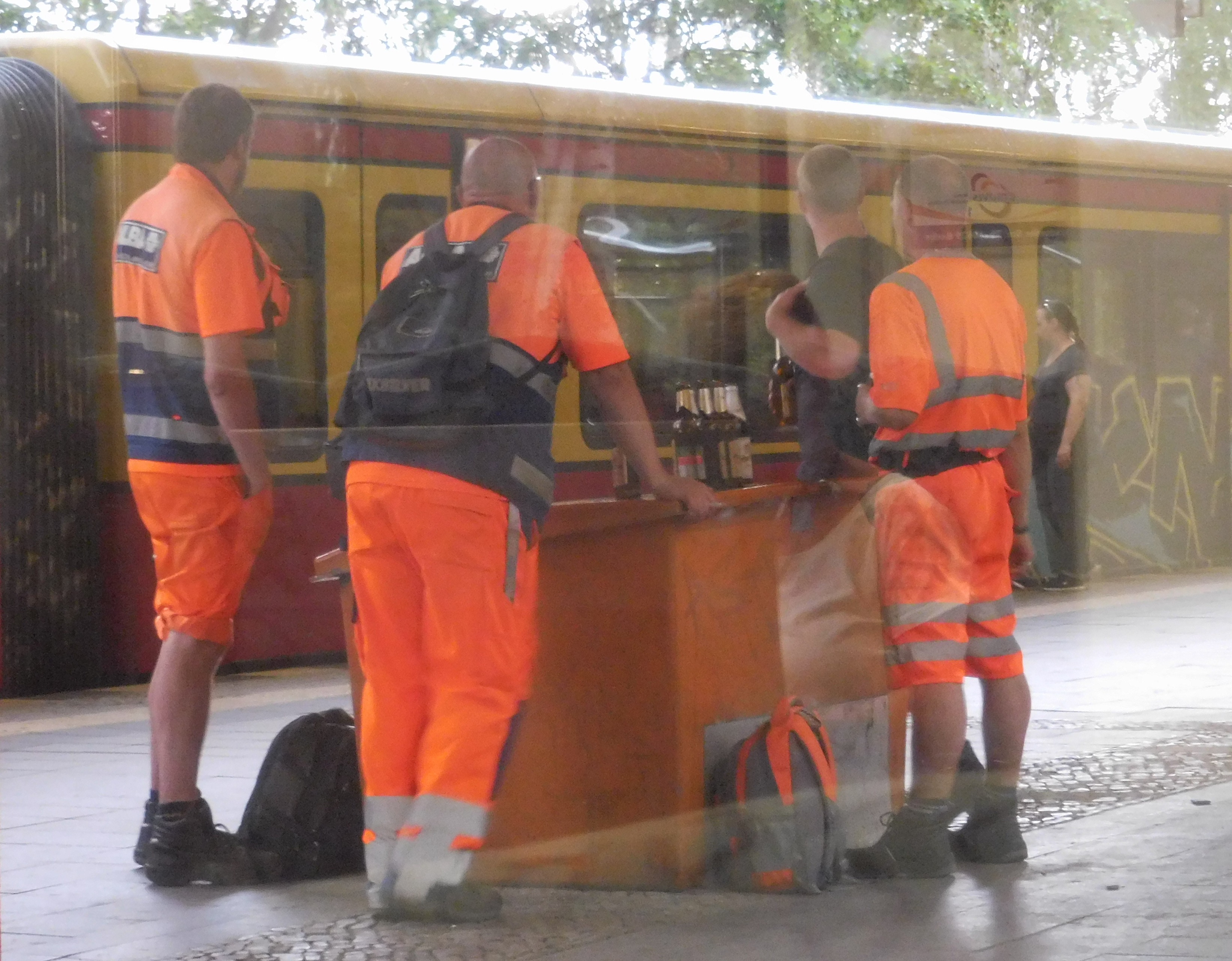
Just a few days before I left town in June, I was traveling up to the Sachsenhausen Concentration camp (more about that later, perhaps), and I happened to see a group of official transit workers…apparently having a little *party* at work. I harkened back to contracted tradesmen in Denmark going through astonishing amounts of beer in the course of a workday, but I found it just a tad astonishing that these gentlemen would be throwing a few back…in uniform, as it were. Maybe they had, er, just confiscated it from a minor and had to dispose of it quickly…

All in a day's work

All in a day’s work

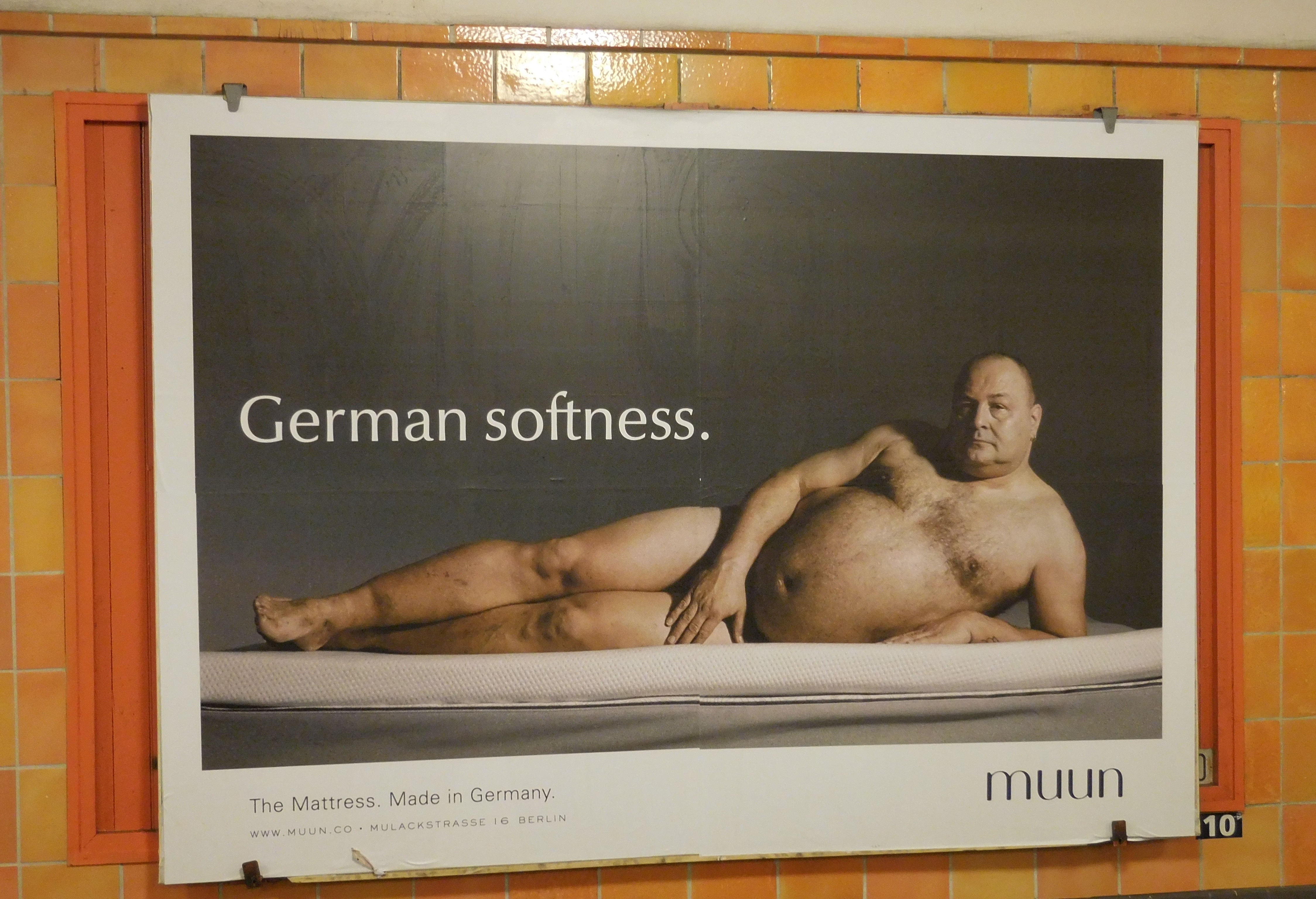
This next picture, advertising mattresses of all things, greeted me early one morning in the subway. It was almost as good as a cup of Sharif’s coffee from the bakery in terms of waking me up:

Dream on, ladies...

Dream on, ladies…

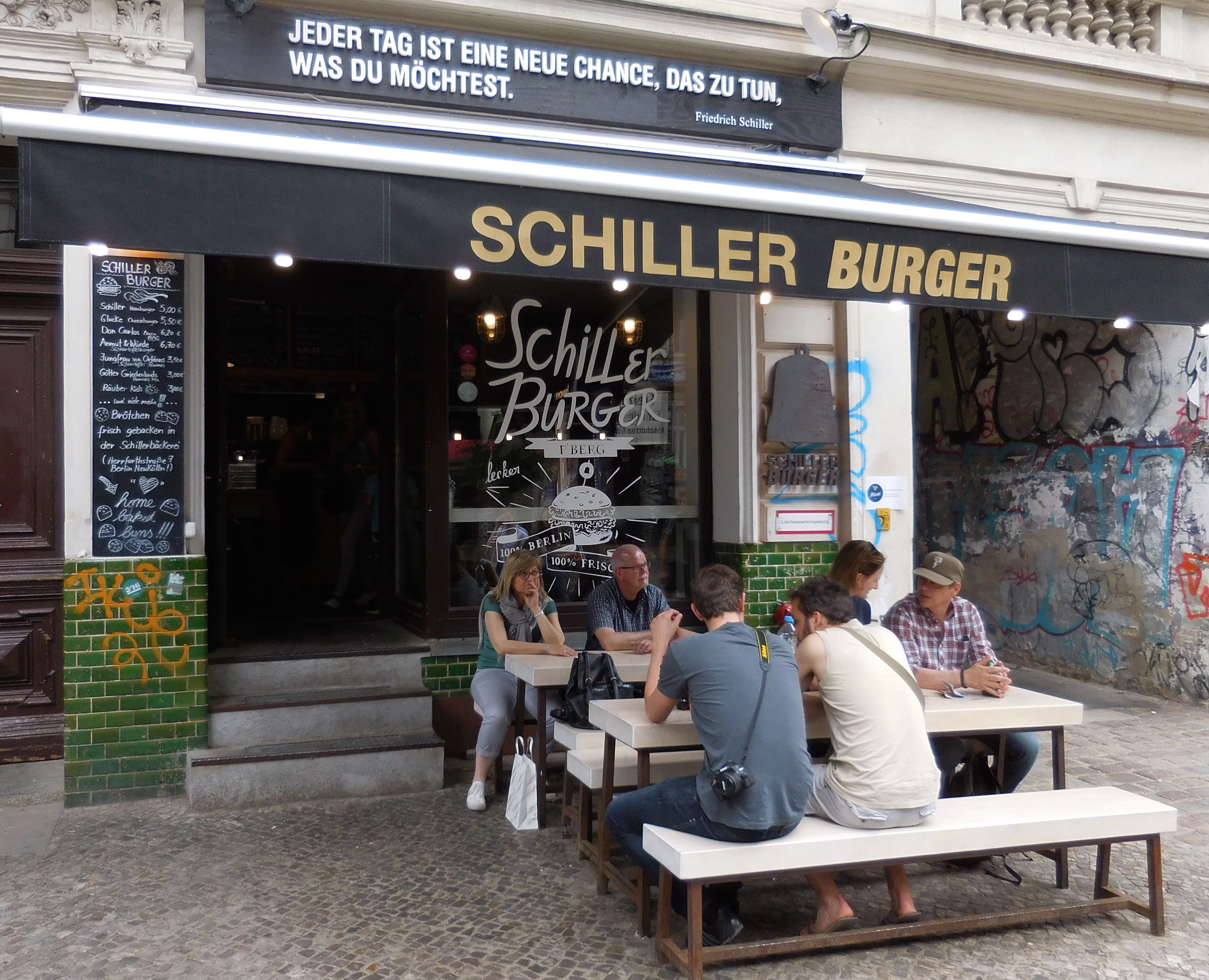
…and I’ll conclude this cavalcade of images with another cafe shot, this one from the Prenzlauer Berg neighborhood, now one of my favorites. Not only is the establishment in question reputed to have some of the best burgers in town, but their facade sports a slogan we should all keep in mind:

Carpe diem

Carpe diem

Attributed to Frederich Schiller himself (I checked; they’re not kidding), the German poet, philosopher, physician, historian, and playwright encourages us all to keep in mind that “Every day is a new chance to do what you wish.” A great reminder of the freedom many of us have, and sometimes forget we do.

***

On a very different note, I have pictures and ideas for three more blogs from my ‘student daze,’ but I’m not sure anyone would care to read them. These are, in no particular order, “Jewish Berlin,” “A Trip to Sachsenhausen,” and “The Gourmet Floor of KaDeWe.” Readers, this is your chance to weigh in. Would you be interested in any of these? If so, which should I do first? I also have material for my time in Denmark, but before I get too distracted, I’d like to see if my loyal readers (and there are more of you than I ever thought possible) have a preference. Either leave me a message in a blog response or write to me privately. Thanks for coming with me on this amazing journey; please know that this blog gives me a great deal of pleasure and encourages me to write better than I thought possible – just by knowing you are reading it.

Posted in Berlin, Germany, Uncategorized | Tagged , | 5 Comments

Fertig….finished….

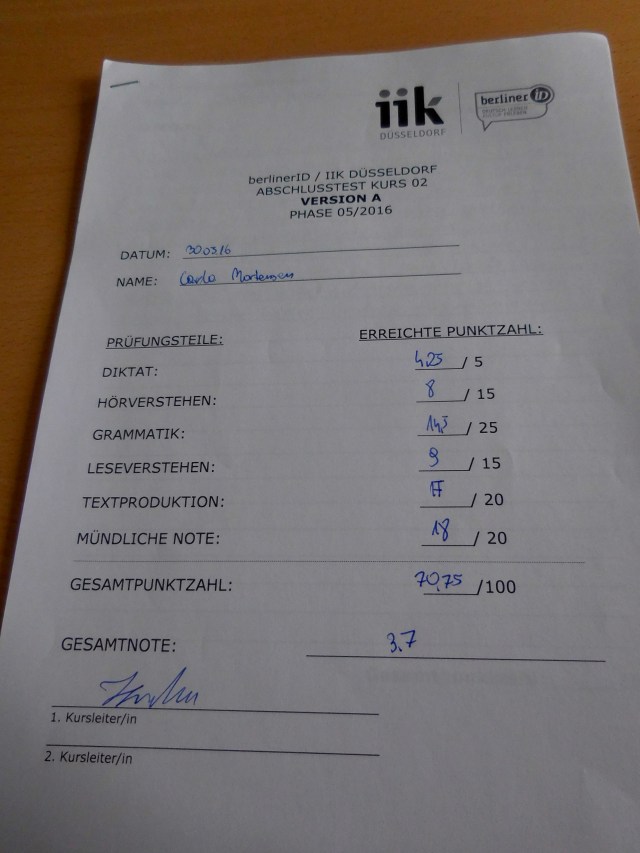
A month-long intensive language course is a strange animal. One barely gets into the routine, learns the way to school, gets to know the teachers and fellow students, figures out how to study (again), begins to feel some proficiency, and WHAM-POW, it’s over. Yesterday we had an exam that covered five different proficiencies for a total of three hours, and today we received our grades (and certificates, if we passed). Here are my scores:

Final grades

Numbers never lie…

What this means is that I got 4.25/5 on the dictation, 8/15 on the listening section (it was HARD; most of us had trouble), 14.5 on the grammar (dang those articles!), 9/15 on the reading section (I thought I had nailed it; guess not), 17/20 on the writing section (well, finally something I can be proud of) and then 18/20 on the spoken section, which basically means our in-class participation – we weren’t assessed on our spoken abilities in the final. My grand total is 70.75 (passing is 65) which basically translates into a high C+. *But about half the class did not pass at all,* so given the length of time since I last studied German (empires have risen and fallen) AND the amount of extra studying I did (nil), I’m delighted. Plus, of course, my main reason for the class was to observe the emotional aspects of language acquisition and reflect on ways to make teaching and learning better for students, and that, unlike the scores above, has been a 100% unqualified success.

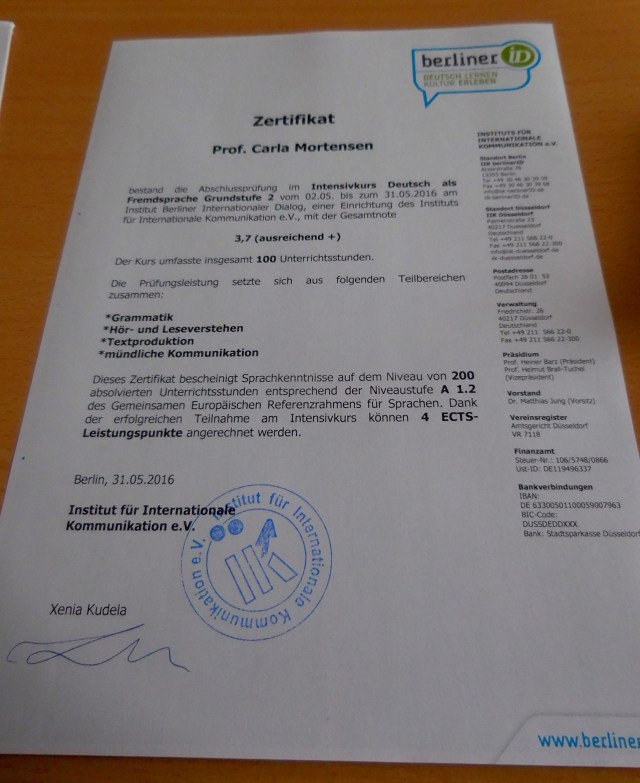
We aren’t allow to keep our final exams for all the good reasons any school doesn’t allow finals out in the wider world, but we lucky ones were given certificates proudly proclaiming our achievement. If I could read it, I would know what they think I accomplished:

Certificate

Well qualified for something, to be sure

But a much better memento is a shot of my stalwart classmates – those who were brave enough to show up in person today to learn their fate this morning:

Class A1.2. with Xenia

“Ich bin…in die Schule….gegangen…”

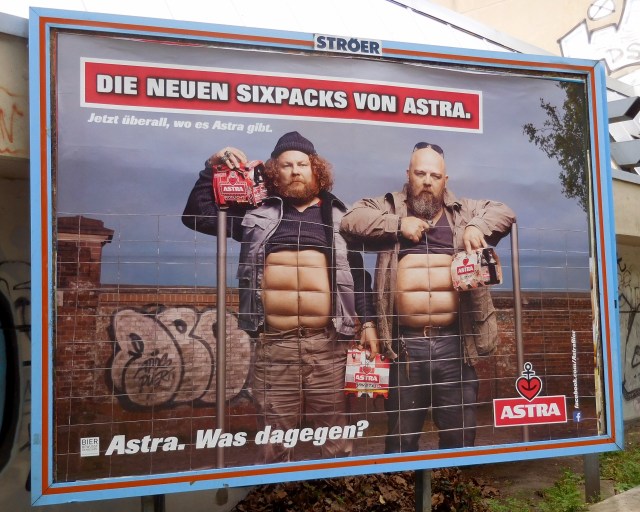
From left we have Hao, Frank, Carlos (seated), Lukas, Tong, Xenia (one of our teachers), yours truly, and Chiara.  Thanks, guys. You’re the best and I hope you all achieve your dreams. But before I get too maudlin, let me share a little local advertising crazy that just caught my eye by way of suggesting what some folks might be up to before the start of the new month of classes on June 6th:

Die Neuen Sixpacks

Abs, Berlin style….

Who knows? I might partake a bit myself.

Next on my agenda is moving out of my student digs tomorrow and into a local hotel for three days to finish my up sightseeing, then a quick trip to Copenhagen to meet a cousin who’s been off the grid up to this point – more on that later. On the 8th of June I head back to the States. But for tonight, I’m feeling a little proud and a little wistful and very very much grateful to all concerned for this grand adventure. Old dog = new tricks. Woof.

Posted in Berlin, Germany, Uncategorized | Tagged | 2 Comments

Ein Wochenende in Nürnberg (a weekend in Nuremberg)

One of the unexpected outcomes of this student excursion was the opportunity to attend my first European pen show. Now as you may know, I have been a member of the national and international pen community for some time now, attending (when I’m able) shows around the US, even having run my own in Portland, Oregon for five years. I have known that there was a European circuit as well, but none of my jaunts had so far lined up with any of the shows on this side of the pond. Happily, my pen buds in Germany clued me into this lovely little show happening last weekend, on the 21st of May to be exact, and since I was ready for a brief step away from my somewhat austere student life, off I went.

Germany boasts a decent – not as good as it was before privatization – railroad system, but alongside that venerable institution has sprung up (is my sentence construction getting more Germanic?) a whole host of national and international bus lines which travel to myriad locations very regularly, offer free wifi, unlike the train, and can save buckets of Euros over the train options. I caught a Flixbus on Friday morning (missing *a whole day of class,* gasp) and five and a half hours rolled into Nurnberg.

As you may know, Nurnberg has a long and august history, first as the unofficial capital of the Holy Roman Empire, later as the the home of Albrecht Durer, then the heart of the German Reformation, and, most infamously, during the Nazi era serving first as the place where the Jews were stripped of rights and then the site of the biggest Party conventions. After the war, the international and military tribunals were held there, as much for those previous Nazi-related reasons as well as simply because the Palace of Justice was largely undamaged from Allied bombing raids.

Well, that’s a weighty history to be sure, too heavy, it turns out, for a gorgeous warm weekend in May. While I knew bits and pieces of all that, I decided to try for a little less ponderous approach and spent my time looking for the smaller stories, which of course, there were in good measure. But let’s start with a tiny bit of history, just so I feel like I did my due diligence.

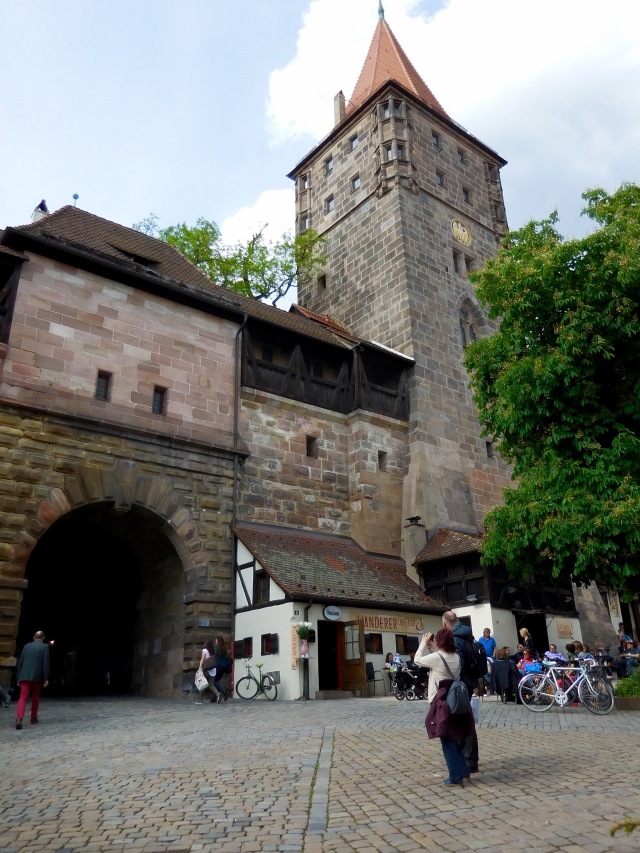
As I so often do, I start at the top and work my way down from the summit of an old city. In Nurmberg, this means hiking up to the Nurnberger Burg, the Nuremberg Castle, extant on that site from around 1140:

N'berg castle tower

Gazing up at history

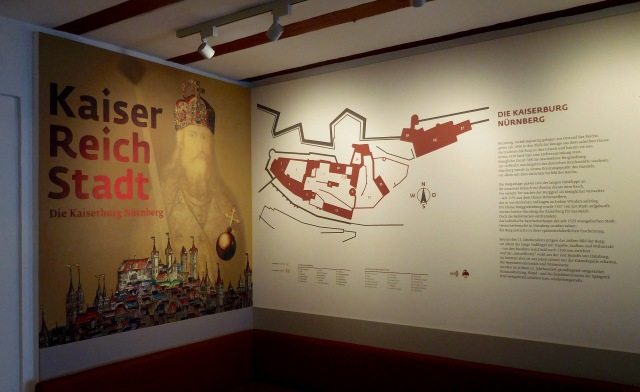
Inside the castle, one is reminded that this was a seat of religious and secular power for a very long time. The portrait is an idealized one of Charlemagne done by Albrecht Durer, and I was able the original later in the weekend.

N'berg Kaiserburg exhibit

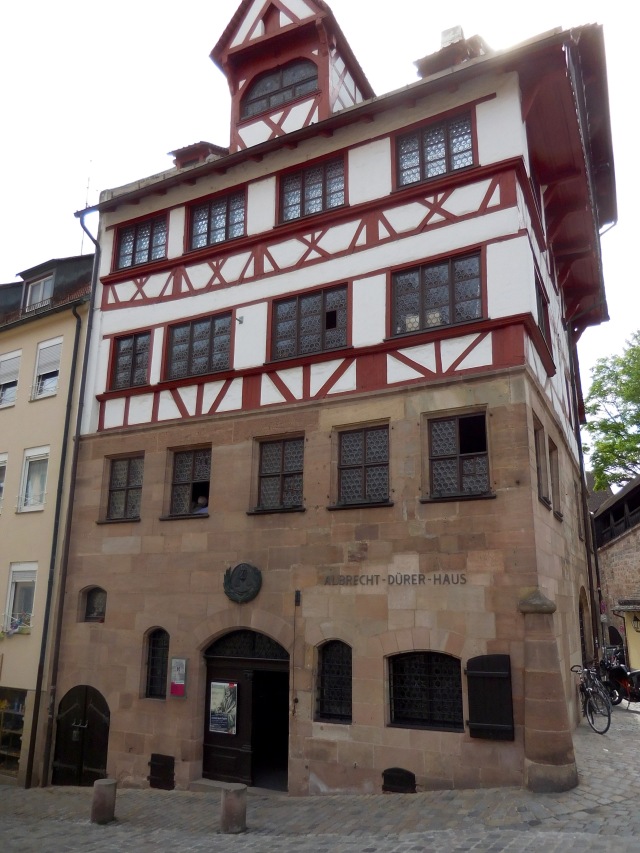
Turning 90 degrees from the castle, one sees Durer’s home itself:

N'berg Durer Haus

The bunny began here

One of Nurnberg’s most famous sons, the great printmaker, portrait-painter and theorist of the German Renaissance had interests that extended far beyond printmaking. He thought and wrote extensively on mathematics in general and concepts around perspective and ideal proportions in particular. He corresponded with Raphael and da Vinci, among others. (I almost bought a magnet in his honor, but was appalled by the price.)

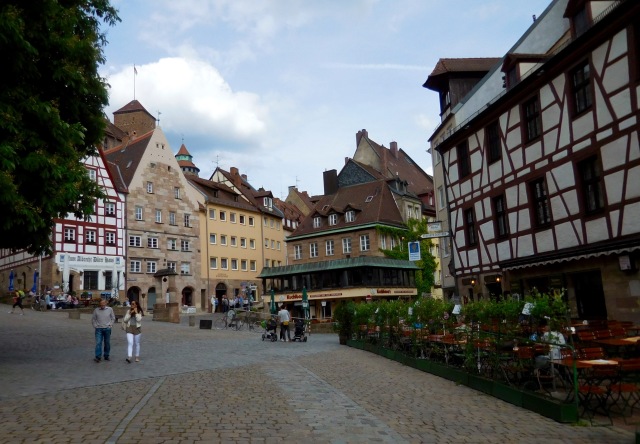
Turning 90 degrees the other direction from the castle shot shows you a lovely early town square:

N'berg square near castle

Idyllic Bavarian scene, complete with der Biergarten on the right.

Near this very spot is the entrance to the World War II German art bunker, “former beer cellars directly under the Imperial Castle” (where) “irretrievable art treasures were to be protected here from fire, smoke, gas and pillaging and secured for generations to come.” Alas, they were not open the day of my visit, or I would have headed down for a look, being such a fan of dark and scary places since my visit to Budapest a couple months back.

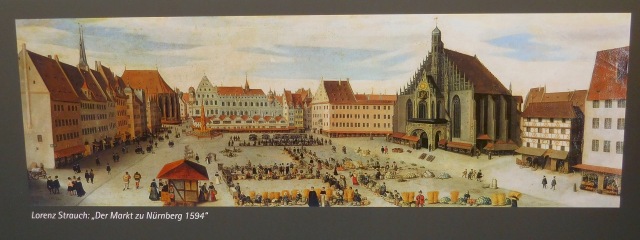
Well, that was the good stuff, or a lot of the good stuff. Nurnberg, like much of Germany, suffered grievously at the hands of Allied bombers. And while most of the churches in town were spared, a lot of the classic buildings that had survived centuries went up in smoke, as it were, and was replaced by not-so-lovely mid-century architecture. Here’s an illustrative example…first, a shot of the of the Hauptmarkt  (Market Square) back in its heyday:

N'berg Old Market Square

Cabbage is king…

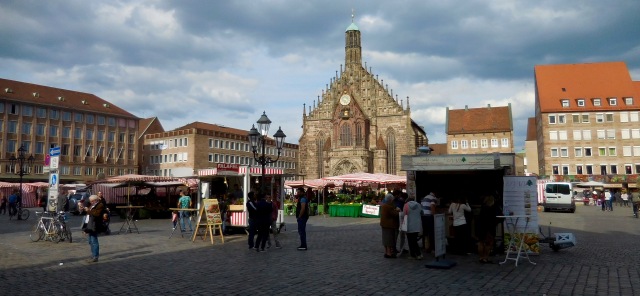
This reproduction of a civic landscape from 1594 is a nostalgic reminder of the tempered beauty of the town at the time. Trying to stand in a similar spot, one today sees

N'berg New Market Square

Sic transit gloria mundi…

The stalls are still filled with beautiful local produce and one can imagine a lovely Christmas market here as well. Still, the idea that post-war bureaucrats decided to put up the buildings on the left in the exact spot of older gems (like most of the rest of the city) is a little disheartening. At least the two on the right look fairly authentic.

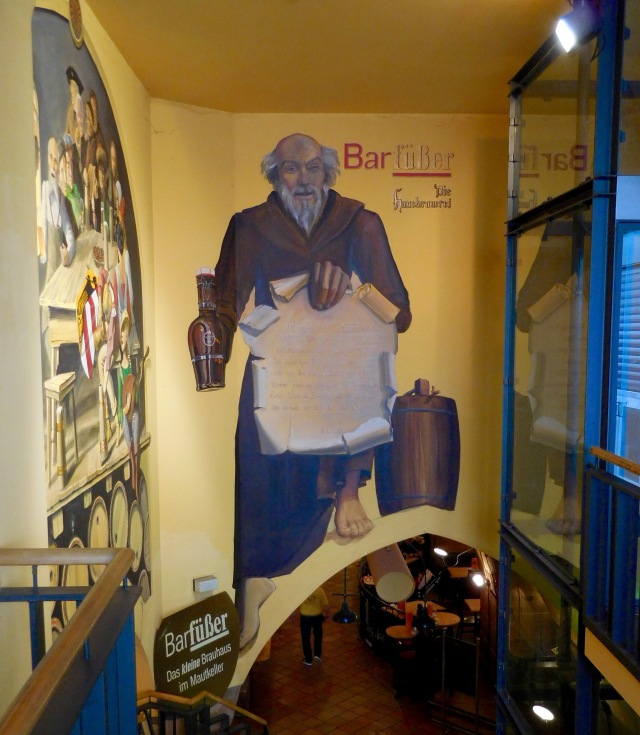
But enough maudlin sentiment. Let’s cheer up. And what better way to do that than beer? Friday evening the assembled pen masses were planning a gathering at a local watering hole, the Hausbrauerei Barfüßer im Mautkeller. When I arrived, I was greeted by a local spirit who has been promising a good time for a long time:

N'berg Monk with beer

Prost!
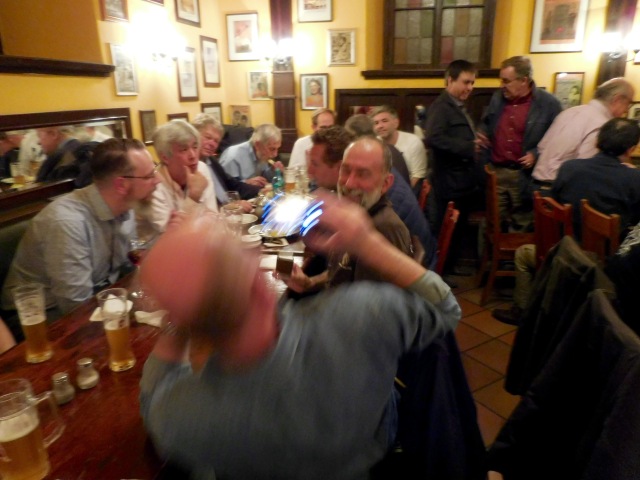
Down the stairs and around the corner I found the pen gang, ready for a rowdy evening and a great day on the morrow. Who was it who said people never really grow up, they only learn how to behave in public? Here’s a group very much enjoying the private:

N'berg pen beer hall

Watermans in the watering hole…

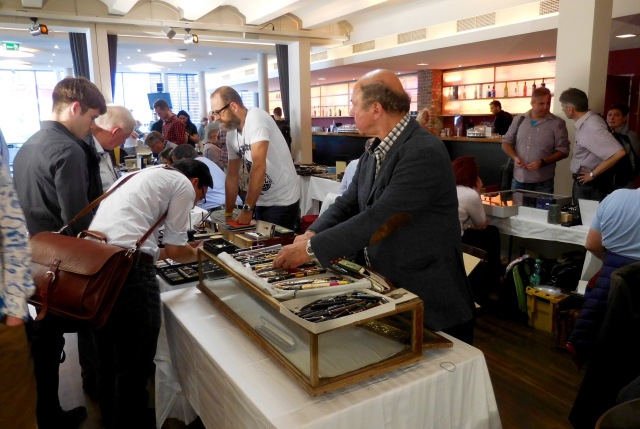
The show itself the next day was the usual orgy of looking at pens, talking about pens, trying pens, buying pens, selling pens, and trading pens, along with cheerful chatter (and more beer, the venue being some kind of bistro, it appears. Here’s a shot of the show itself, small but mighty and filled with a number of wonderful folks whom I have known about and corresponded with for years but never met in person:

N'berg pen show

Montblanc run amok

Since I couldn’t afford what I *really* wanted, I contented myself with trying nearly every pen in the show and buying two very modest writing instruments. My collection will never be what it once was, but the friendships I have started and maintain through this community are priceless indeed.

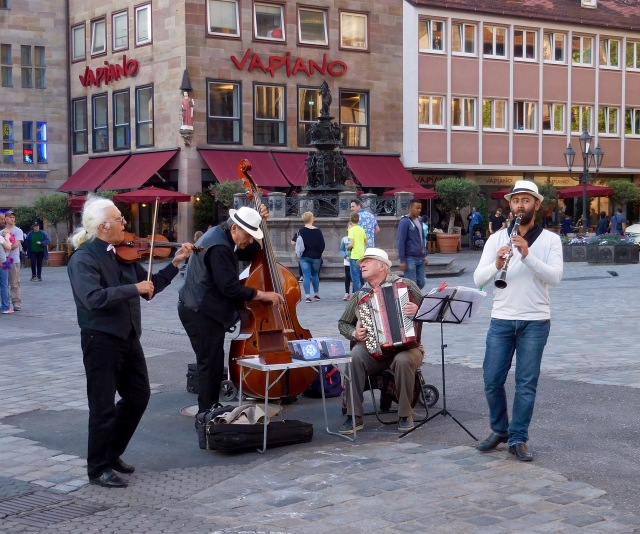
On my walk back to my hotel that afternoon, I saw that Nurnberg has, like many other lovely old towns, turned itself into what I struggled to accept the Czech Republic – the soul of the city, IMHO, turned over and into a tourist paradise. The Altstadt is filled with trendy over-priced shops and trendy overpriced cafes and a overly friendly busker on every corner singing every possible type of song for every possible type of visitor. Charming in a superficial and very commercial way would be my evaluation. But amidst this orgy of 21st century consumerism, one group stood out as being rather remarkable in this time and place:

N'berg Kletzmer band

L’Chayim!

Yes, that’s a Kletzmer band…playing Yiddish music…performed by Russian Jews….in Nurnberg…while a little blonde German girl dances nearby under the indulgent gaze of her father….all photographed by Chinese tourists.  It was too much. My head was spinning. But I have it here to share with you, the amazing way the world moves on, one way or another.

A little further along, I was charmed by the bubble maker, as were a good number of the younger set. As an aside, that was *the only hijab* I saw during my stay in town, Bavaria in general being less open to outsiders than Berlin.

Not so tiny

Not so tiny

The next day, Sunday, was miraculously International Museum Day. Nurnberg, joined by host of many other cities, apparently, threw open the doors of *all* of its museums (and there is a long list) for free or a one Euro entrance fee. I went hog wild. I could talk for hours about this, but I’d just drive us all nuts. The highlights were the Germanisches Nationalmuseum…

http://www.gnm.de/en/

(…if you want to see more), AND a wonderful set of three connected 15th century houses that have been lovingly restored to show off their former function and glory. Workshops on the ground floor were covered by the domestic living space of the artisans and their families that lived there….for nearly 600 years. The rooms were impossible small for the large families that were the rule; the floors were uneven, the ceilings low, the kitchens primitive, the stairs narrow and rickety. But it some way I felt a sense of awe of sharing, for a brief moment, a warm and welcoming space that so so many had called home for so so long.

And then it was time to catch the bus back and return to Berlin. It was a most enjoyable and inspiring time away, all things considered. I keep marveling at my good fortune that I am able to see all these things and to fill my mind with times and places of which I have been unaware all these years. Thank you for coming along with me on this part of the journey – it makes it so much richer to know, as I sit here typing, that you are willing and interested in sharing with me.


Posted in Germany, Uncategorized | Tagged , | 2 Comments

Ein typischer Tag – a typical day

So now that I’ve mostly reclaimed my sanity (mostly), let me share a little of a usual day with you. Remember there have only been five of these – a combination of placement test, national holiday, and weekend mean that although I left Maine two weeks ago, I’ve only been at this crazy venture for five class days (or 21 hours), a quarter of the course, more or less.

Here’s a shot of my “home away from home,” the little bakery downstairs staffed in the morning (I learned today) by a lovely man from Afghanistan, Sharif, who has only been in Germany for four months. My German is only marginally worse than his, it turns out (we’ll learn together). Here is where I slurp my first cup of joe and check my email before setting off for school, roundabout 8:00 am or so:

Bakerei with wifi

Garden of Earthly Delights

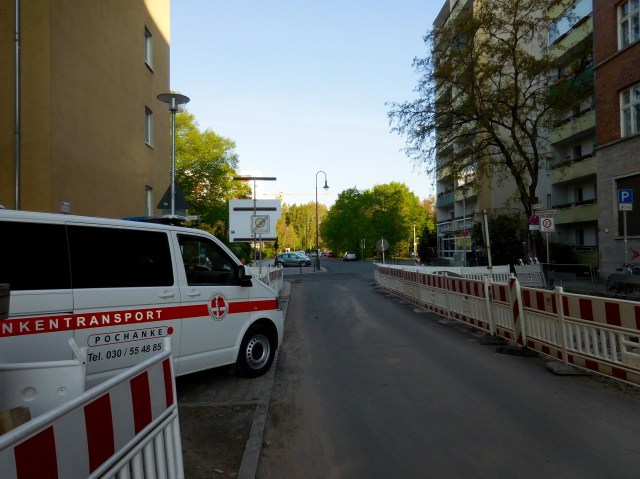
Here’s the view as I leave from the door on the right above and set out to school. My travel time is about 30 minutes – 10 to the subway, 10 on the train, and 10 to the school. (On the way home I usually find some interesting walk or other to clear my head.)

Setting off

“Always becoming…”

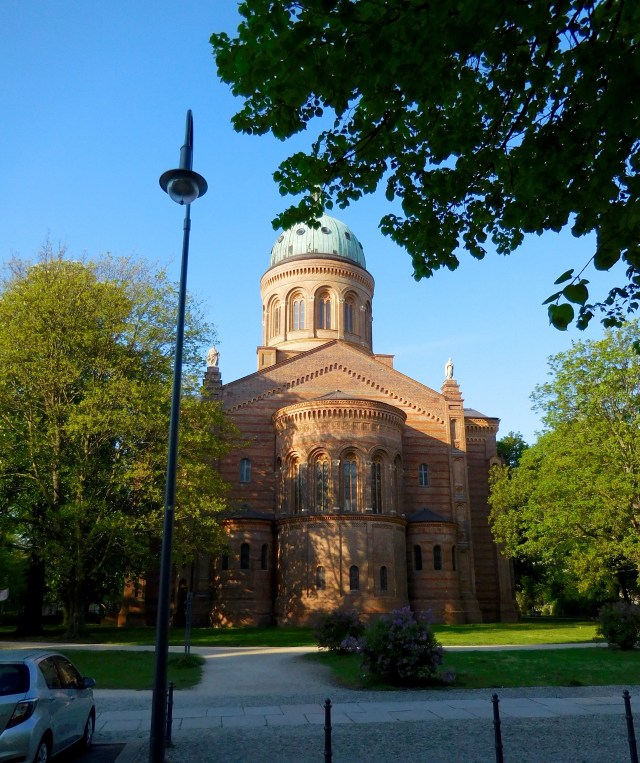
Along the way I pass this lovely church, the Roman Catholic classic St. Michael’s Church, complete with May lilacs blooming at the moment:

Kirche on route

A prayer for improved comprehension in is order today…

Before long I arrive at “my” subway stop:

U-bahn station

Unprepossessing but oh so convenient

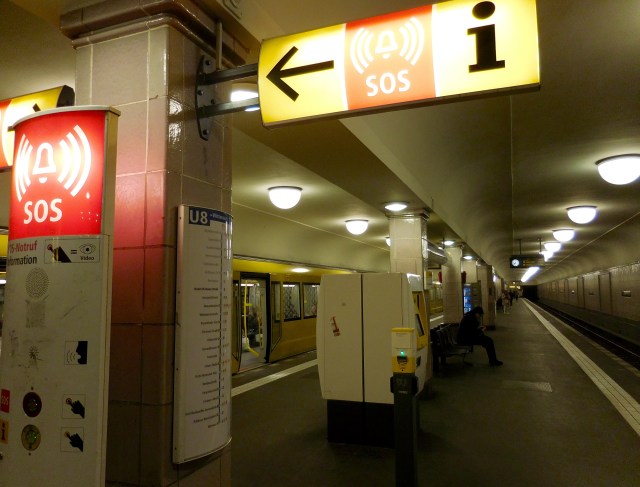
…and down the hatch we go to wait for the next train. They’re never more than five minutes apart at rush hour…

Waiting for the U-8

Never far from help or infomation

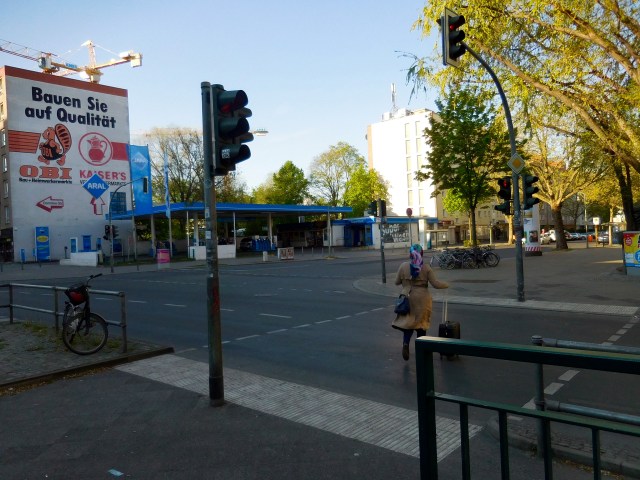
…and six stops later on the U8 pop I out and begin the trek at that end:

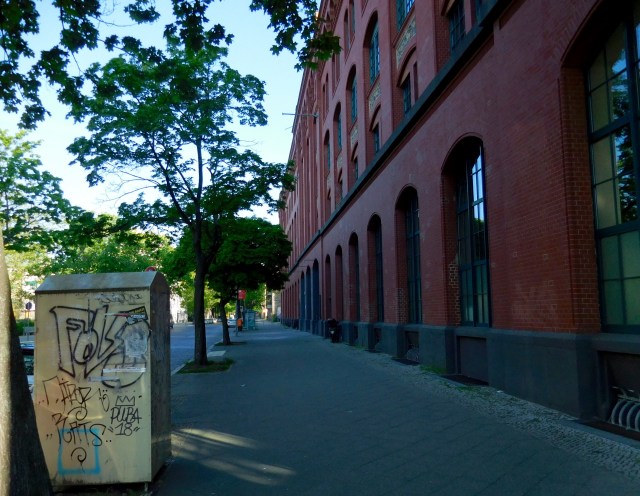
Walk from u-bahn

Berlin is nothing if not trains and cranes

Here I am arriving at school – a wonderful old electric factory turned into multiple educational enterprises:

Arrival at school

Abandon hope all ye who enter here…

I’m deliberately not identifying the school for reasons mentioned below, so forgive me if I don’t give you a lot of details about the interior. I have to share, however, a little about the audio experience here. There is a bi-lingual primary and secondary school in residence, and the voices of die glücklichen Kinder beim Spielen – the happy children at play – resound *all day long.* Charming, but loud. Today someone is banging on a drum as well. But it beats a lot of urban sounds, and it’s great to see and hear kids actually playing with each other as opposed to hunched over mobile devices.

Die kleine kinder...

Young global bilinguals

To prove that I am actually beating my brains out learning German, here’s a snap of the most useful thing I did today (it was extremely helpful…simple, but effective) – a game with two of my classmates to help us beat the Dativ into our brains:

Dativ game

Yaba do..

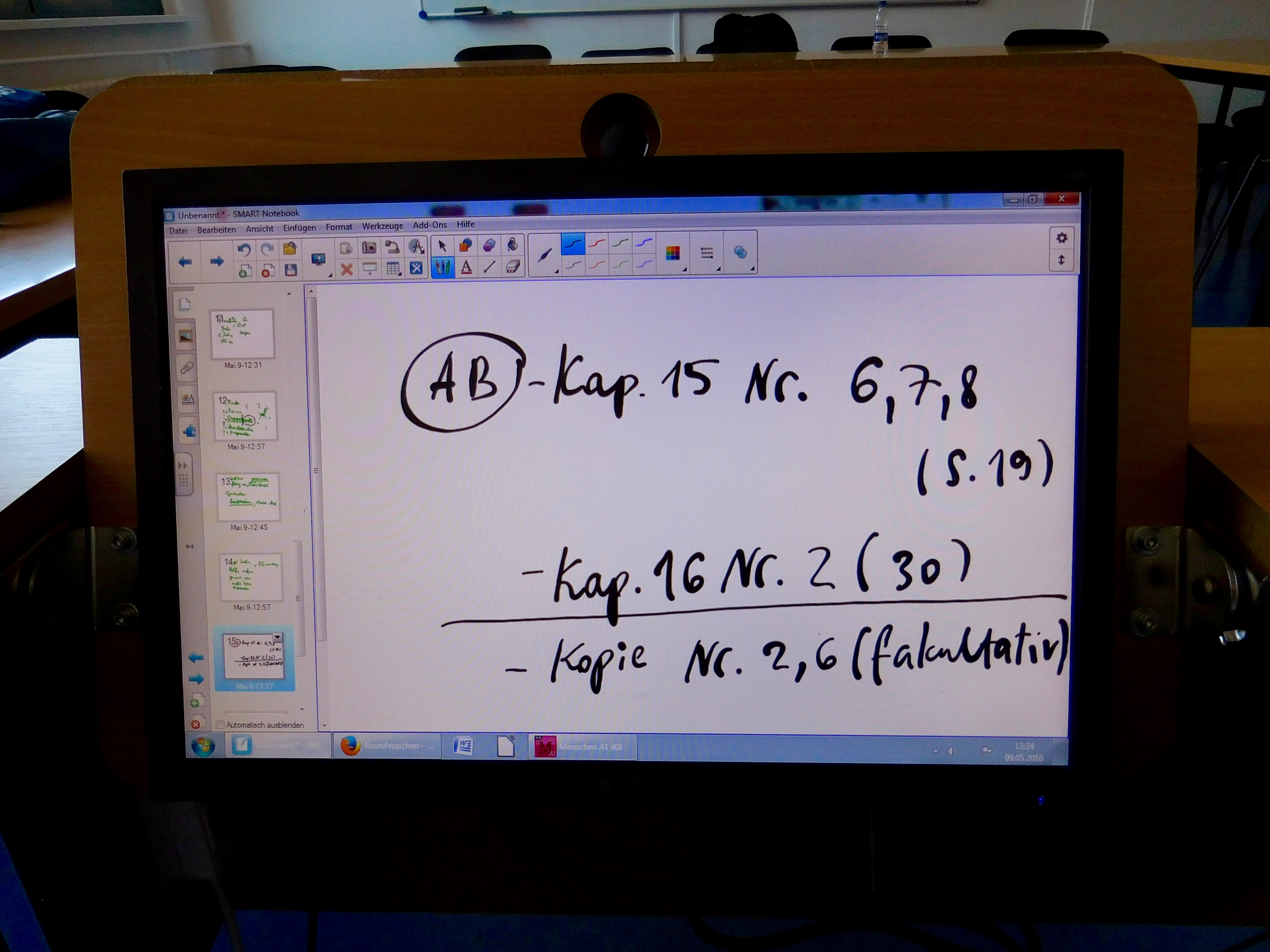
…and a shot of something that’s really cool for teaching – a smart board! The teacher writes on the white board with a special “pencil” and then the computer keeps track of every page she writes and she can return to it by just touching it (like a PowerPoint presentation – the green small pages on the left below). So, for example, if you write out a whole bunch of vocabulary, that page is electronically saved and you can return to it later in the lesson. This page, however, is our homework…

No rest for the wicked

No rest for the wicked

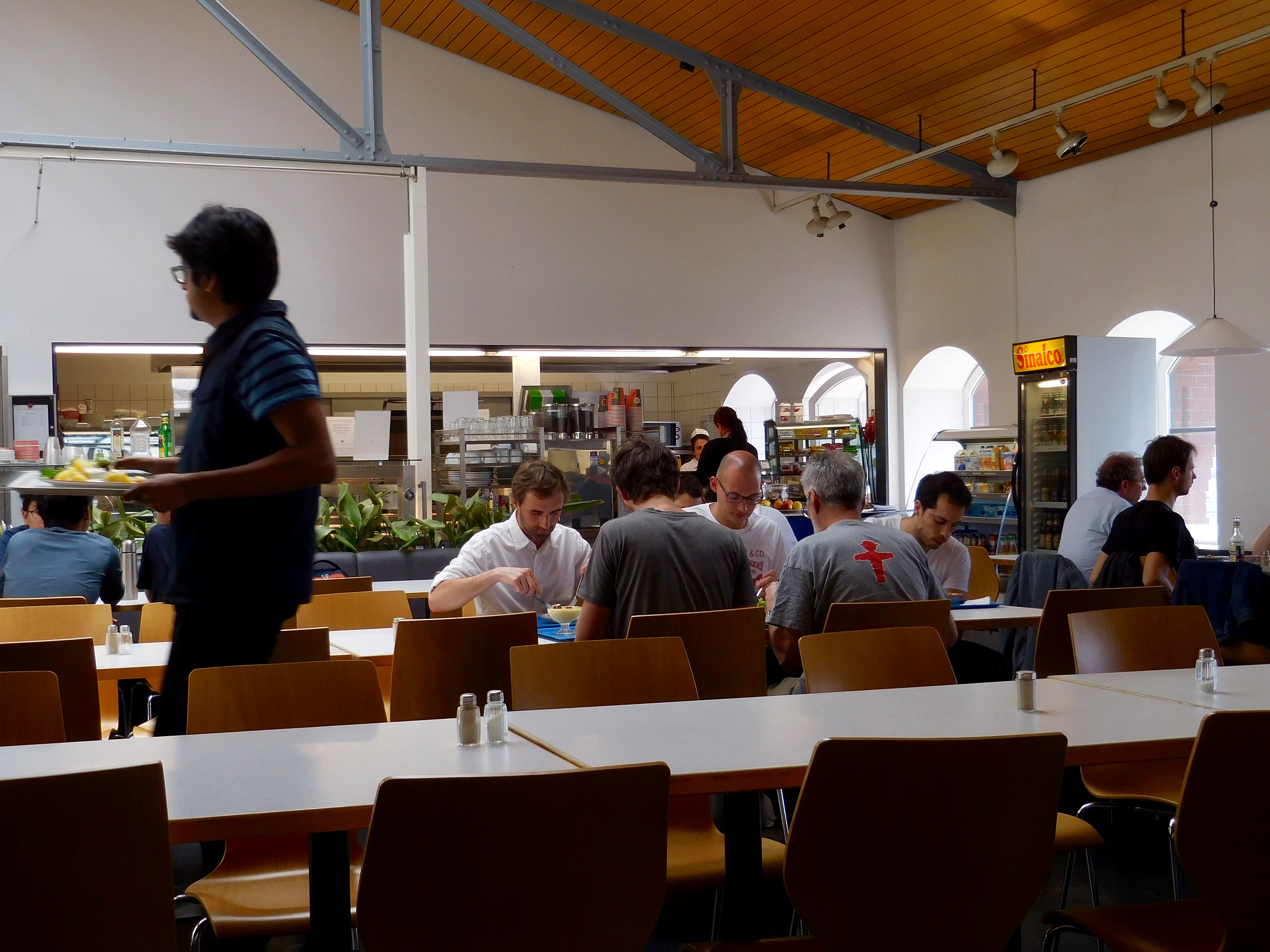
So when 1:15 pm finally rolls around, we’re all pretty bushed. One of the reasons I chose this particular school is that, because of the multiple educational entities in the complex, there is a dandy little cafeteria on the floor above us that serves a nice little variety of luncheon specials every day at student prices. Here’s a shot of some of the other inhabitants of the building genießen ihr Mittagessen – enjoying their lunches:

Guten Appetit!

Guten Appetit!

Usually after lunch I head back downstairs to hang out in the student lounge for a couple hours to use the excellent fast and free Internet and to try to plow through most of my homework before I completely flat-line. Here’s a shot of the room taken early in the am when it is unpopulated (except for my rucksack in the corner) – most of the day many of the chairs are filled.

Cozy nook

Cozy nook

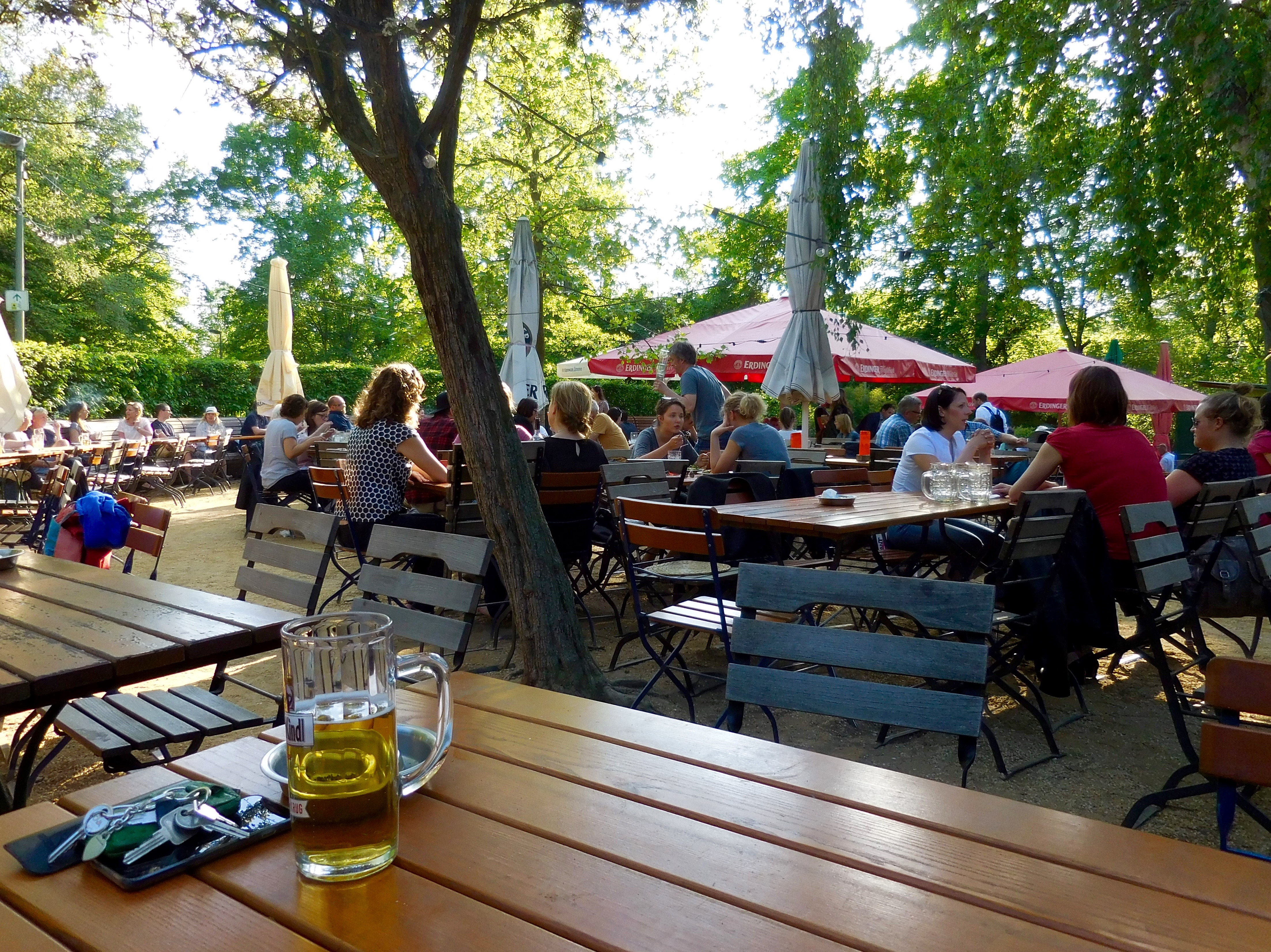
Around now, that is 4:00 pm, I pack my bags and head out for the trip back down to my digs. Since it stays light here until well after 9:00 pm and the weather has been beautiful, this usually turns into some lovely ramble through some or other part of the city I have not yet explored. Last night, though, was a bit of a departure – my good friend Kurt invited me to the Schleusenkrug Biergarten to meet with him and a couple of his friends. This was no tribble atall, as you can imagine. So here’s a shot of my view from Kurt’s table into the chillin’ crowd. And the Pils wasn’t bad, either.

Evening relaxation

Prost!

On that note, I will leave you for a spell. Don’t doubt for a moment that I’m having a wonderful time.

Posted in Germany, Uncategorized | Tagged , | 2 Comments

Es ist verdammt schwer, Deutsch zu lernen

Okay, folks, this is Day 4. Monday. I had a lovely weekend. I did all my homework. I even did extra reviewing of the material from last week. I slept well. I had coffee.

But today I hit the wall. Just about 10:30 am this morning, about an hour and a half in to the first day of the second week, my mind went completely blank. Even staring at the board, at my book, at my notes, I couldn’t put phrases together. I understood the structure, I understood the grammar behind the structure, I understood the words, I understood the relatively simply task the teacher set before us.

But.Nothing.Came.To. Mind. Nichts. Nada. Zilch. Basically my mind was one big “WAHHHHHHHH!” Boy, did that feel like Hundkot (dog sh*t).

So this is a sliver of what it’s like, day in and day out, for beginning second language learners. Managing the academic content is one task, managing the emotions is another one, and in some ways, a more challenging one, as I am quickly learning.

The teacher noticed my state, and of course came to check in on me. I said I would explain after class, and I did. She is a lovely person, smart, a good teacher, a sympathetic human being. I told her, actually, this was the experience I was trying to have, that I had signed up for, that I wanted to learn from. But that didn’t make it any easier in the moment to cope with a room full (well, only ten, down from our original fifteen) of people looking at you, waiting for you…to…say…something. Not that they are all speeding along, not at all. The older Taiwanese woman, the chef, was equally frustrated. I caught the Australian’s eye and we both shook our heads. I’m not alone by any means.

Now, how to learn FROM this, how to translate this into my teaching practice. One thing is that two hours is a long time to sit. I think I will try to move my students around a bit more, even walking to the board helps. Also, I think it’s important to take breaks between oral work (listening, guessing, repeating ) and written work (looking at the sheet of paper quietly, doing some practice to reinforce). Personally, I’m having trouble with too much oral input at the moment, not enough reflective time. In my Foreign Service days, we called this “drinking from a fire hose.” You know you are gulping for all you’re worth, but a lot is still getting by you and sloshing down your clothing nonetheless.

Four days down, sixteen to go. I wonder when the fog will lift?


Posted in Germany, Uncategorized | Tagged , | 3 Comments

There IS a god…

Miracle of miracles, the little bakery downstairs (run by a lovely pair who play Arabic music) *has free wifi.* I am saved. I am sitting there now with some decent coffee and a strudel of some kind. I don’t know how long this place stays open in the evening, but they ARE open this morning, which is a German holiday. This bodes well for my internet access (but probably not for their health).

Thanks to you dear ones for expressing concern on my wifi meltdown and echoing my discomfort. In truth, I did indeed feel good bit of anxiety last night when I thought I had no way to reach anyone or anything. We are so totally dependent on these devices now….

Today, a beautiful sunny cool spring day, I’m heading over to have lunch with my buddy Kurt. He is back from a longish trip to Laos and a quick run to Batumi, so much to discuss. Then back home to homework. Because today IS a holiday, they gave us twice as much….


Posted in Berlin, Germany, Uncategorized | Tagged | 2 Comments

…GO!

Much to my utter shock and amazement, on the basis of one (count it ONE) ten-week German language class at Occidental College in the spring of 1975 (and a passing acquaintance with the Danish language), I placed out of the introductory German class (A1.1) and into the “minnow” class (A1.2). While this is clearly a great complement to Herr Professor A., it means I will probably have a bit of catch-up to do and may spend a good deal of class time with the “deer in headlights” look on my face. My fellow students at this level have already worked their way through a rather substantial 12-chapter textbook. We’ll see how this turns out.

But before we go much further, a quick word about language learning and assessment in Europe. All languages taught and tested are based on the CEFR, the Common European Framework of Reference for Languages, which consists of a set of acquisition levels based on time in class, topics taught, and proficiency attained. What that means is that a grade of A 1 (introductory) or B 1 (intermediate) or C 1 (advanced) is pretty much the same across languages, schools, and grading scores. As you go up the levels, each section takes a little longer and means you are more proficient in that language according to a set of testable variables. A 1.1 is “I don’t know diddly” and C 2.2 is the equivalent of someone functioning at the master’s level. I first encountered this most reasonable system when I was teaching in Georgia and I felt like a king-sized idiot that I had neither heard of it or knew where in the US it was even in use. Just chalk it up to yet another one of those useful and widespread metrics that the world is cheerfully running along on and of which we in the US are cheerfully ignorant.

Coursebook

I’d certainly like to be able to talk to him

This morning sharply at 9:00 am I took my seat in my classroom, joining a woman from Italy, a man from Palestine, another man from the US, a woman from Taiwan, and five students (male and female) from China. I am clearly the oldest, although the Taiwanese woman, a teacher herself, is probably in her 40’s. The rest are college-aged (as far as I can tell). Our teacher J, a lovely woman probably in her 30’s, was born in Russia and grew up in Berlin. In addition to Russian, German, and English, she speaks a little Spanish and Portuguese. (It’s just so damn humbling.) Happily, the lingua franca at the school (used for announcements and anything really important that they don’t want us to miss) is in English. Boy, am I lucky. Class runs from 9:00 am to 11:00 am, then a break to 11:30 am, and then another stretch until 1:15. This is considered five class units (45 minutes each, even though the timing doesn’t reflect that exactly). I myself have never taught a class longer than two hours and 45 minutes, including a 15-minute break in the middle – my hat’s off to the whole team for a schedule that sustained in terms of teaching concentration.

So it was off to the races this morning with J acting out lots of words and having us guess what they were (auf Deutsch, naturlich), playing tapes of conversations, pairing us up to do worksheets with other students, and trying to teach us to puzzle out the use of the appropriate prepositions and articles for the damn Dativ case (location). We talked a lot about how the bank is next to the police station and the dog is on the sofa and so forth. I took copious notes during class which I have just finished re-copying into my crisp fresh notebook, and I’m feeling quite proud of myself, all things considered.


Notes

Work in progress

As part of this language learning exercise, I have already had a chat with Herr Director, ‘outing’ myself as an English teacher interested in observing another second language classroom in action to scout out best practices. He was delighted and intrigued and asked that we meet over the course of the program to discuss what I have seen and how what they are doing there compares to my experiences. So I am taking notes not only on the language, but on the language teaching as well (mostly things I am impressed with, only a few where some tweaking might be considered) and I am looking forward to the conversations to come.

But before you think I’m some kind of uber-kind, let me tell you today was hard. It was hard to sit and focus that intently for that long, to hear so much language I didn’t understand. It was hard to stare at a list of words and to try to remember what the article is (der, die, or das (singular) or die (plural)) and what the resulting dative form would be (dem or der (singular) or den (plural)). It was hard to see youngsters rippling this stuff off their tongues (the Palestinian man, as were my Arabic students in Portland, clearly the most at ease in the classroom). And by the time I staggered out of the classroom at 1:15, I was simply a tired pup.

Thankfully this week there is a holiday on Thursday (Ascension?), so after tomorrow’s class a little “pause.” (I’ll be having lunch that day with my buddy Kurt, so that will be a great treat.) Then Friday followed by a weekend. It’s only next week that the pedal will hit the metal with five straight days of class in a row….but listen to me, will ya? I’m not doing this because I have to, to form a new life in a new country because I can’t go back to my own country. I’m not doing this because my academic or professional life and that of my entire family depends on it. I’m simply doing this because…I am curious and interested to learn more about language and language learning, and because I have some free time on my hands. Nothing hangs in the balance except some minor ego adjustment. And to be humbled from time to time, me thinks, is a great blessing in itself.


Posted in Uncategorized | 2 Comments

Wifi 101

So I’ve had my official first “everything is not perfect in Berlin” moment. Wi-Fi. Can’t live without it, right? So as you may recall, shortly after I arrived I learned the unhappy fact that there is no Wi-Fi in my accommodation. This is completely understandable from an organizational and administrative point of view, as I explained below, but pretty frustrating from my personal “I can’t live without internet access” point of view. So today, like several other similarly disillusioned new arrivals, I trudged off to the Saturn store in Alexanderplatz to obtain a Wi-Fi stick and a sim card.

USB

Now during my days in Batumi, I had become completely enamored of (and dependent upon) a small USB stick with a monthly allotment of gigs as a marvelous way to carry around one’s internet access and avoid the dreaded TWC installation experience that awaits most of us as we set up cyber-shop in a new venue. Buy the stick and pay a very reasonable monthly fee – presto magic, the internet follows you and your laptop around the environs like a well-trained pooch. In fact, I was downright pissy when I got back to the US in the summer of 2013 only to learn we didn’t even have such devices available. Pah. We’re so 2002.

Fast forward to this afternoon. Brimming with confidence and bravado, off I go to slay the tech dragons and emerge victorious, a USB stick and sim card that will make my life here perfect clutched tightly in my hot little hands.

(You know this isn’t going to end well.)

First of all, Saturn is one of those gynormous soul-sucking multi-story commercial establishments, selling a mind-bending array of electronic devices that, under the best of circumstances, usually reduces me to quivering, sweating frustration, eyes brimming, voice catching, in under 15 minutes flat. Just imagine that all, but auf Deutsch, naturlich.

images

Step One. Establish that USB sticks are on the third floor. Find the escalator and head up multiple levels. Find sticks at far end of the floor. Head back down to sim card section on first floor. Run into fellow student who tells me USB sticks will not work with Macs.

Step Two. Go back up to third floor, chat with a sales associate. He scans in the bar code of the stick I have chosen and confirms that it does, indeed, work with Macs. Back down to the sim card arena.

Step Three. Try to puzzle out sim card section. First, do I want a German card or an international card? (Is the internet German?) Nice sales lady tells me I need the international version. Then I have to pick 8 or 16 or 32 or 64 or 128 gigs. How much do I need for a month? To be able to play Bubble Witch Saga and to interview my fellowship applicants on Skype? I settle for 32. It’s a number. The prices aren’t too different.

Step Four. Stand in line to register the sim card. Ooops, can’t do that before you buy it.

Step Five. Purchase stick and sim card. This sets me back about 60 Euro, but ya gotta have the internet.

Step Six. Go back to sim card area with proof of purchase. Stand in line again. Nice young man takes my passport and fills out a lengthy online form, probably one that goes directly to Interpol. I reflect that I certainly won’t plan any terrorist actions using that sim card ‘cuz they’ll find me in a heartbeat.

Step Seven. Since I don’t know what I’m doing with a stick and sim card to begin with, I head over to the Service Desk to ask for installation advice. Take a number. Wait for next available resident genius. Oh, this is an installation? Go down to the desk at the end of the counter.

Step Eight. Special desk at end of service counter. Nice young man explains that it will cost an additional 19 Euro to do the installation. This seems a little dear to me, but since I don’t want to get all the way back home and then not know what the hell I’m doing and break the damn thing, I agree. He sets out to get the stick ready, pops card in stick, pops stick in computer…

Step Nine. Nichts. “Device will not connect.” We try several times. Nice young man goes deep into the computer and learns that because I am running an earlier version of my operating system, the stick cannot register itself with my OS. Tells me it will take two hours for the new OS, EL Capitan, to download onto my laptop. I flash on the near future, sitting in the corner of this megalithic technology superstore counting sheep while the software downloads. I try to think of it as a learning experience and agree to do it.

Step Ten. I need my Apple password to download the new OS. I don’t have my f-ing Apple password. I have my Facebook pw, my Outlook pw, my Expedia pw, my blog pw, my bank pw, a few other pws, but not the Apple one, not thinking there would be any need for it during a German language class in Berlin. But the sad truth remains. No pw, no free download, no stick, no sim card, no internet.

Step Eleven. My eyes fill with tears and I look across the counter into the sympathetic face of the Nice Young Man. I suggest he really doesn’t want to see an old lady cry in right front of him just right now. He nods gently and writes something illegible on my crumpled service ticket #107. I take it and my now useless purchases to the same cash register where I had bought the stick and the sim card about ten minutes ago, confident that this horror will soon end.

Step Twelve. My receipt and the scribbled note from the Nice Young Man are not sufficient to reimburse my funds. I have to go back up to stickland on the third floor and get approval from the very same sales associate I had worked with there twice before to verify my return.

Step Thirteen. I show my handwritten note from the installation guy to the guy in stickland (after I track him down). He prints something out from his computer that apparently will do the trick. I head back down to the first floor.

Step Fourteen. I go back to the same cashier (we’re almost sharing recipes at this point) and she is able to reimburse me for the stick, but not for the sim card (since it’s registered to me and no one but me). I grab my documentation and stagger out of the store into the bright spring sunlight of Alexanderplatz, considering myself fortunate to have survived the experience, sim card or no. I guess I’ll be spending a little more of my leisure time at MLS (my language school) where the Wi-Fi is free and the doors don’t lock until 6:30 pm. So if you don’t hear from me as often as you’d like, this is the reason. Sic transit gloria mundi.


Posted in Uncategorized | 6 Comments

On your mark…get set…

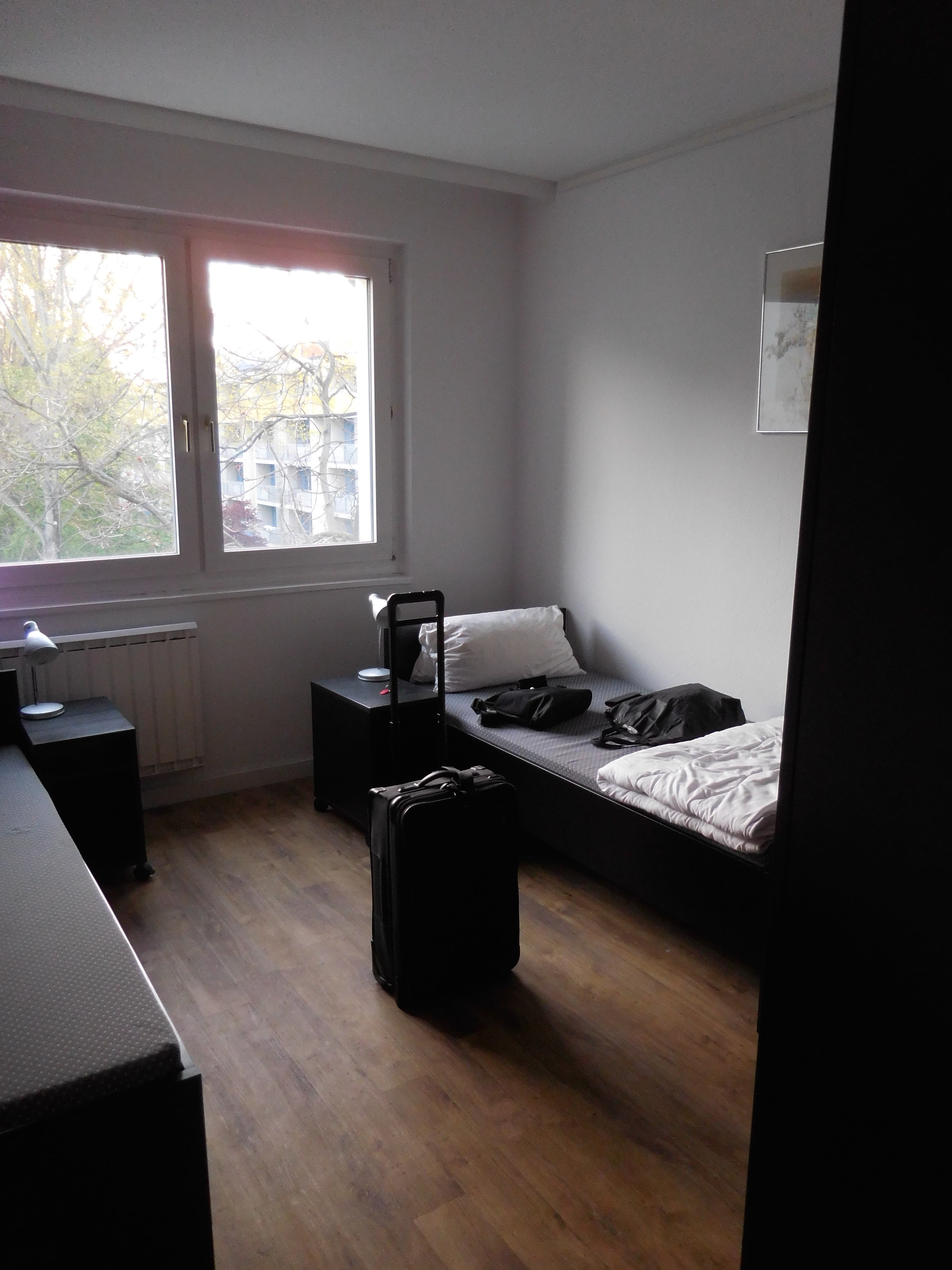
After several days playing around in Berlin (more about that in a moment), I settled into my student digs last night in preparation for the beginning of my language course today. If I were asked to describe my shared flat, I’d say “modest” and leave it at that. For those of you who know me well, it’s probably somewhere between Batumi and the Co-op. But the bed is decent, and that’s saying a lot.

Keepin' it simple

Keepin’ it simple

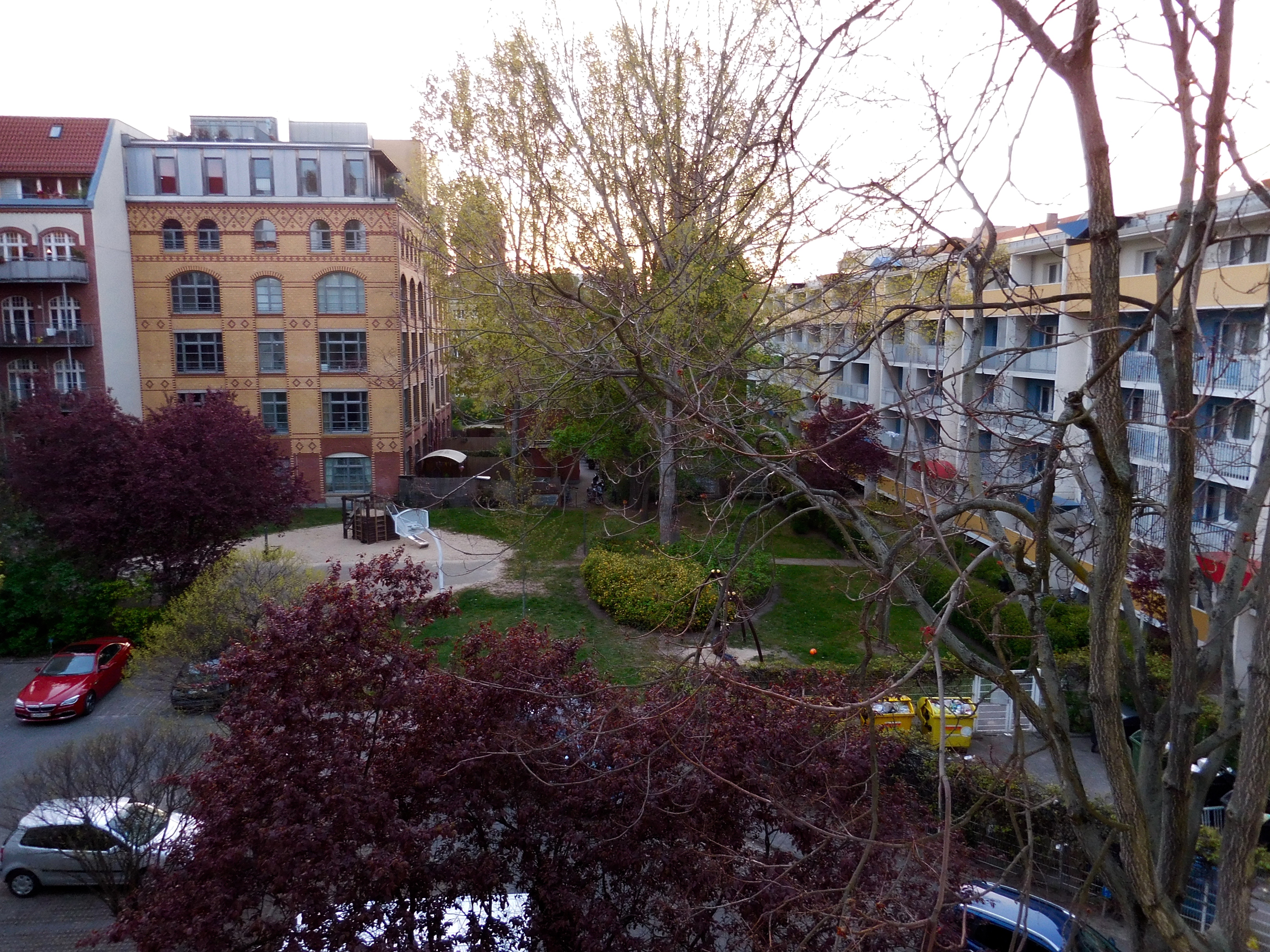
While the flat comes with furniture and kitchen basics, on the down side there’s no wifi because some former student broke a barrel of German cyber laws by downloading copyrighted materials (and getting the school charged 6,000 Euros in the process) so that amenity went by the wayside. But there are some unexpected compensations. This morning I was awakened at 4:30 am by a cacophony of bird songs in the courtyard behind my flat – warblers, chirpers, doves, crows – all rejoicing in a new day and inviting me to share the beauty with them.

My view of the aviary

My view of the aviary

So, up early this am and out the door to face my first day of school. But before anything else, I had to find a cup of coffee. There is a small so-so bakery downstairs with decent brew, so initially caffeinated off I went to the subway to arrive in time for the 9:00 am placement test. No problem there – six stops away. Once on site, it turns out they weren’t ready for me/us, so I started by cooling my heels in the “library” appreciating the excellent free wifi and catching up with news and notes, while the pleasant and obviously busy staff scurry around.

I won’t be identifying this school for several reasons, the main one of which is that I plan to be very honest and that isn’t fair to an organization that didn’t sign up for a “secret shopper.” The second reason is that this is the internet, after all, and I want to protect the privacy and security of my colleagues here. So we’ll just call it My Language School (MLS).

The placement test has come and gone (can you spell “KEIN DEUTSCH”?) and I’ll be getting my results later this afternoon. Following that little exercise, the director himself, a lovely man, gave us a nearly two-hour orientation on everything from German dos and don’ts to all the get-togethers they have planned for us to get to know each other and to speak German. English is probably the lingua franca for most of us, so it will be a bit of a challenge to stay in character, as it were. The newbie bunch of us featured eleven students in a range of ages from countries including Italy, the Philippines, Great Britain, Singapore, Switzerland, Poland, Chile, Saudi Arabia, Nepal, and the US. I may have forgotten one or two, but you get the idea. One of the placement questions featured a sentence that read something like “There are over 500,000 foreigners living in Berlin, hailing from 186 countries.” That’s pretty damn international.

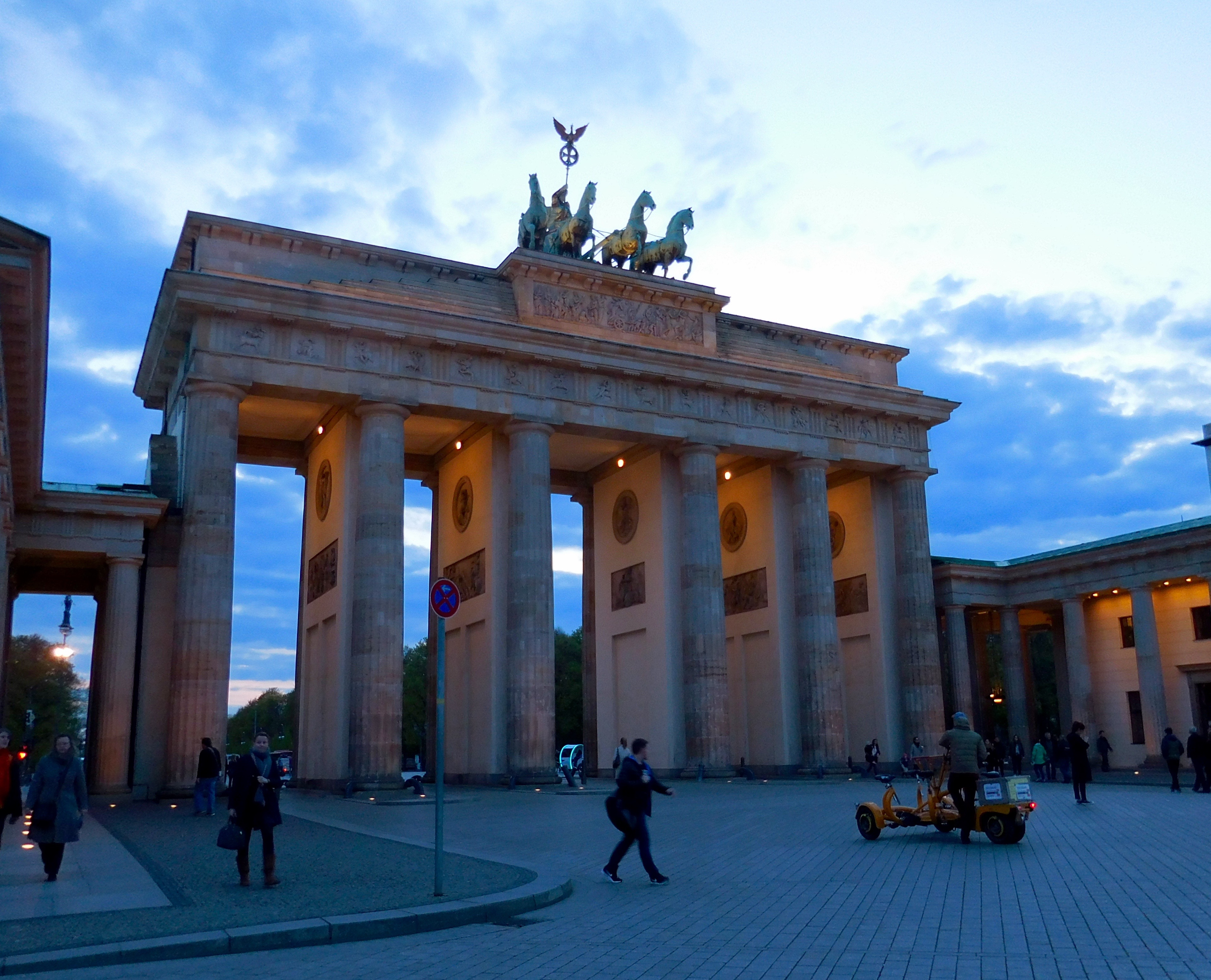
So we’re officially finished for the day although there’s a welcome party a little later this evening (if I can stay up past 8:00 pm). I’m going to head out to find an Internet USB stick, so wish me luck. But before I go, here are a few pictures from my first few days here. First, a lovely shot of the Brandenburg Tor (Gate) at dusk:

Springtime NOT for Hitler

Springtime NOT for Hitler

One of my goals for this trip, though, is to move away from the beauties of Berlin and to spend a little more time digging deeper and trying to understand the not-so-photogenic parts of the city. Berlin is, believe it or not, quite poor and very gritty, with an arty edge that makes one think everyone here went away to university and never left. Aside from the tourist spots, fancy hotels, and shopping streets, a very different urban environment quickly reveals itself, often consisting of large construction sites or whole sections of neighborhoods covered with street art.  Amazingly, this spirit was beautifully captured over 100 years ago, even before the horrors of the 20th century had begun to reveal themselves: “Berlin ist eine Stadt, verdammt dazu, ewig zu werden, niemals zu sein” (“Berlin is a city condemned forever to becoming and never to being.” (Karl Scheffler, author of Berlin: Ein Stadtschicksal))

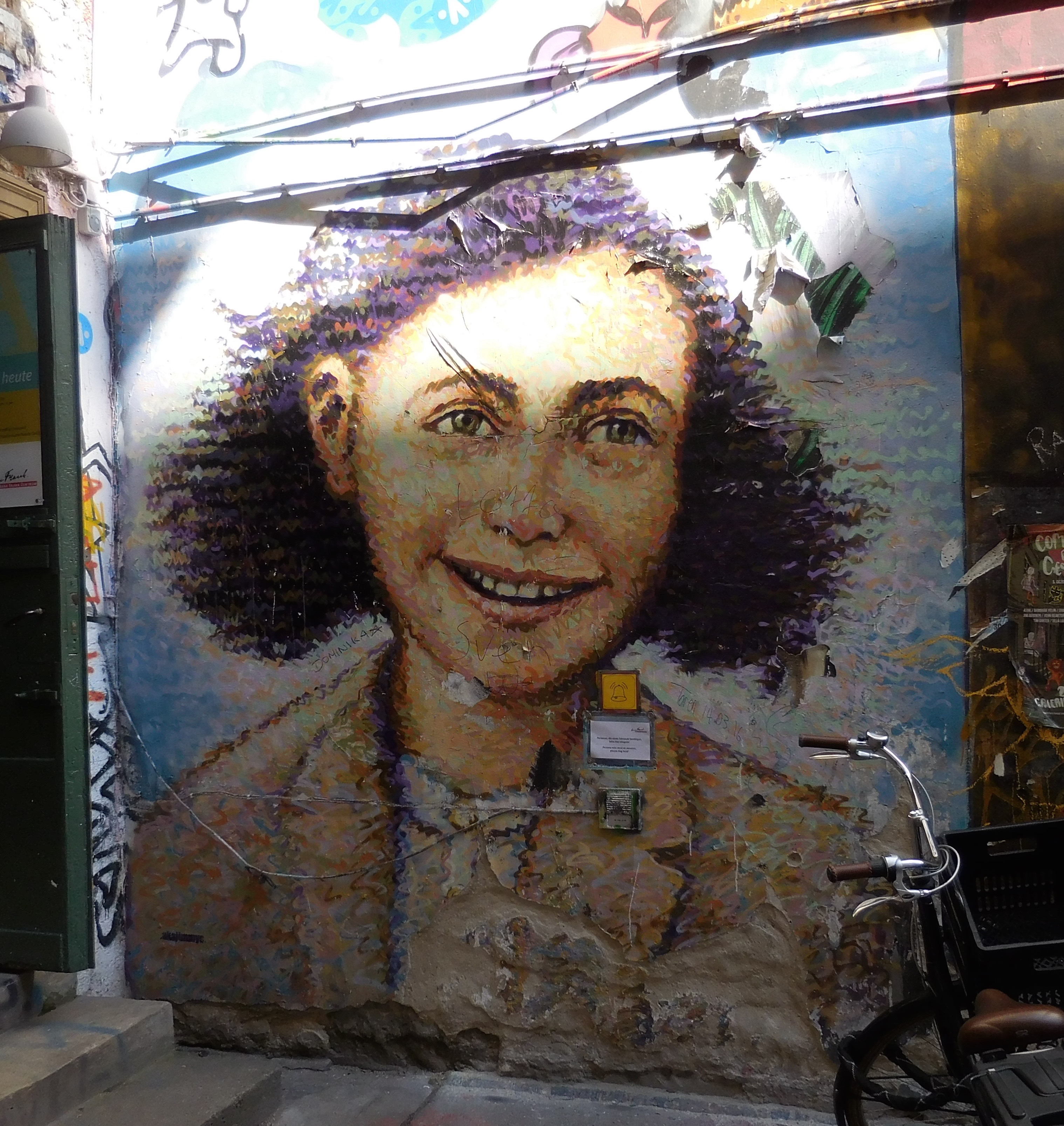
In that spirit of being and becoming, here’s a great piece of urban art featuring Anne Frank, currently gracing the Haus Schwarzenberg done by an artist who goes by the name Jimmy C:

Still inspiring

Still inspiring

So in addition to book larnin’, this month I’m going to make an effort to spread my wings, as it were, and look beneath and museums and cafes. Part of this is because Berlin appears to be “Ground Zero” in Europe for the process of Islamic integration and refugee asylum, so I’m eager to learn how that’s going and what that looks like moving forward. If the old world is going to survive in any sustainable and civic-minded way, its cities are going to have to start looking a lot more like this one. You won’t be surprised to hear I already have some thoughts on this, but they will have to wait for another time.

More to come.

Posted in Uncategorized | 2 Comments